On this page
- Ao Nang in 2026: Still the Best Base in Krabi — If You Know How to Use It
- What Ao Nang Actually Is
- Getting to Ao Nang
- The Beach Scene and Getting to Railay
- Rock Climbing, Sea Kayaking, and Island-Hopping
- Where to Eat and Drink
- 2026 Budget Reality
- The Main Road and Evening Atmosphere
- Choosing Where to Stay Within Ao Nang
- Frequently Asked Questions
💰 Click here to see Thailand Budget Breakdown
💰 Prices updated: October, 2026. Budget figures are estimates — always verify before travel.
Exchange Rate: $1 USD = ฿33.60
Daily Budget (per person)
Shoestring: ฿900.00 – ฿1,800.00 ($26.79 – $53.57)
Mid-range: ฿2,150.00 – ฿4,000.00 ($63.99 – $119.05)
Comfortable: ฿6,000.00 – ฿12,000.00 ($178.57 – $357.14)
Accommodation (per night)
Hostel/guesthouse: ฿90.00 – ฿750.00 ($2.68 – $22.32)
Mid-range hotel: ฿1,400.00 – ฿3,500.00 ($41.67 – $104.17)
Food (per meal)
Budget meal: ฿70.00 ($2.08)
Mid-range meal: ฿250.00 ($7.44)
Upscale meal: ฿1,000.00 ($29.76)
Transport
Single metro/bus trip: ฿30.00 ($0.89)
Monthly transport pass: ฿1,155.00 ($34.38)
Ao Nang in 2026: Still the Best Base in Krabi — If You Know How to Use It
Ao Nang has a reputation problem. Visitors who did their research five years ago sometimes arrive expecting a quiet fishing village and find a fully developed resort strip instead. Others expect a party hub and find it surprisingly low-key compared to Phuket or Koh Samui. The truth sits squarely in the middle. In 2026, Ao Nang is exactly what it has always been best at: a well-connected, comfortable base from which you can access some of the most dramatic coastline in Southeast Asia. The trick is not treating it as the destination — it’s the launchpad.
What Ao Nang Actually Is
Ao Nang sits on Krabi‘s Andaman coast, roughly 20 kilometres west of Krabi Town. It is not an island — it is a mainland beach town, and that distinction matters more than most people realise when they are planning their Krabi trip. Because Ao Nang is on the mainland, it has roads, ATMs, pharmacies, proper hospitals nearby, and regular transport connections. That makes it fundamentally different from island destinations like Koh Lanta or Koh Phi Phi, where logistics get complicated.
The town curves around a single bay backed by steep limestone karst cliffs. At high season the beach fills quickly, the main road buzzes with tuk-tuks and motorbike taxis, and every tour operator on the strip will try to sell you a Four Islands day trip. At low season — roughly May through October — the water gets rougher, some boats stop running, and the crowds thin out dramatically. Both versions of Ao Nang have their appeal.

What gives Ao Nang its character in 2026 is the mix of people who use it. You have honeymooners staying in clifftop resorts above the bay. You have backpackers in guesthouses one street back from the beach. You have Thai families running restaurants that have been there for twenty years. And increasingly, you have longer-stay visitors — people working remotely who use Ao Nang as a quiet, connected base rather than a party stop. The town absorbs all of them without feeling chaotic.
Getting to Ao Nang
Krabi International Airport is the obvious entry point, and it sits about 45 minutes from Ao Nang by road. In 2026, the most practical option for most travellers is the airport minivan service, which costs around 200–250 THB per person and runs frequently throughout the day. Private taxis from the airport cost 600–800 THB for the whole vehicle and take the same amount of time — worth it if you are travelling as a group of three or four.
From Krabi Town, shared minivans leave from the main terminal area and cost 150 THB per person. The journey takes about 40 minutes depending on traffic. There is no direct public bus between the airport and Ao Nang — you need to either book the minivan through your accommodation or arrange it at the airport’s transport counter on the ground floor arrivals hall.
From Bangkok, Thai Airways, AirAsia, and Nok Air all operate direct flights to Krabi. The flight takes about 1 hour 20 minutes. In 2026, AirAsia added a second daily direct route from Don Mueang, which has made last-minute booking to Krabi noticeably cheaper than it was two years ago. Return flights can now be found from 1,400 THB one way if you book at least two weeks ahead.

Coming by bus from Phuket or Surat Thani is also possible. The Phuket–Krabi route runs daily, takes about 2.5 hours, and costs around 200–300 THB. From Surat Thani, an overnight bus connects to Krabi Town, where you transfer to the Ao Nang minivan.
The Beach Scene and Getting to Railay
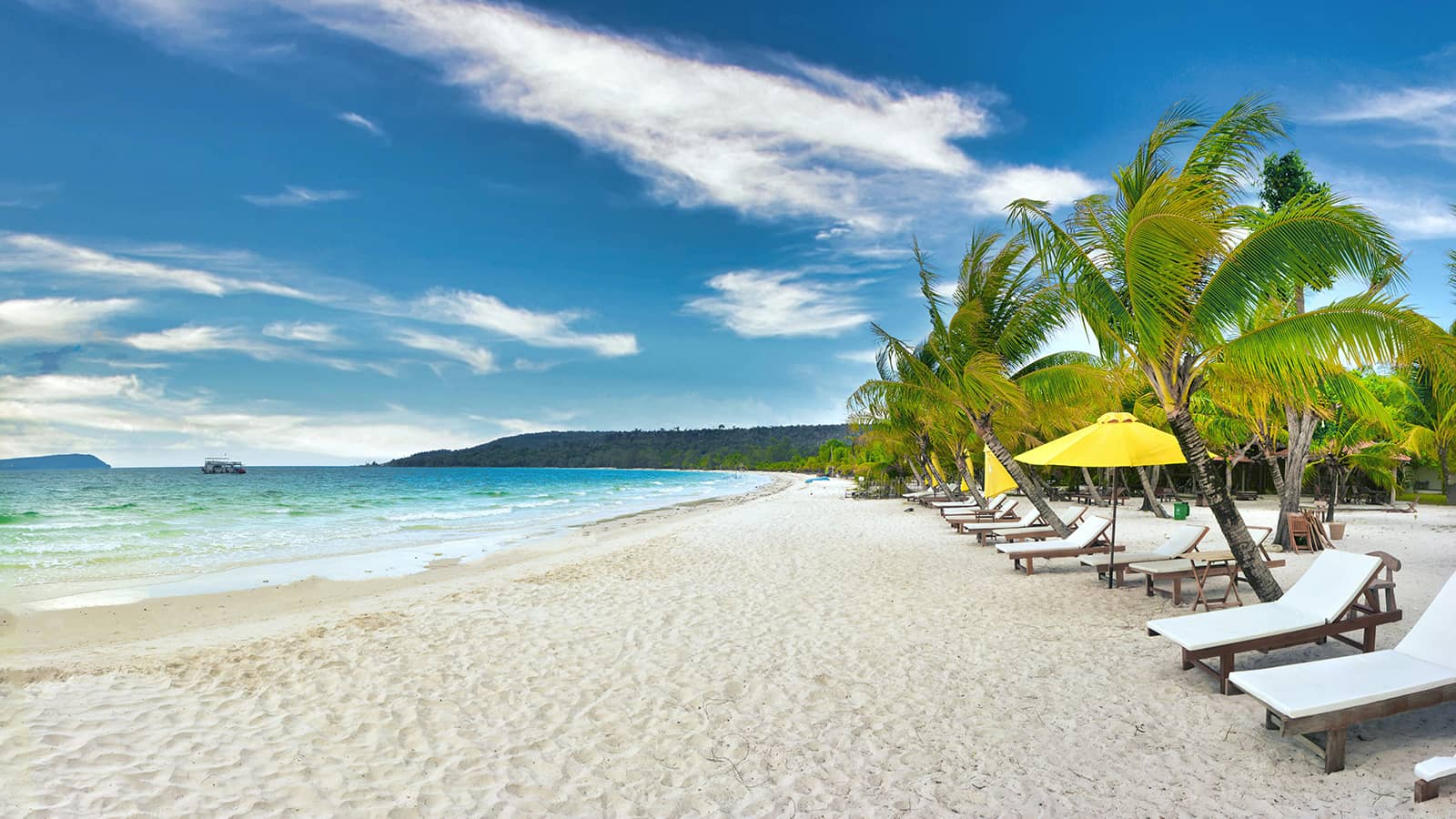
Ao Nang Beach itself is a 1.5-kilometre arc of sand with calm water in dry season and views dominated by limestone towers and mangrove edges. It is not the most beautiful beach in Krabi — not even close — but it is reliably clean, sheltered, and swimmable from November through April. The water is that particular shade of green-grey that turns brilliant turquoise when the afternoon light hits it right, and the limestone formations rising directly from the sea just offshore make even a basic swim feel cinematic.
The real reason most people base themselves in Ao Nang is the boat access. Long-tail boats leave from the western end of Ao Nang Beach continuously throughout the day. The most important destination they serve is Railay — a peninsula that can only be reached by boat because sheer cliffs cut it off from the mainland. The fare to Railay is 120 THB per person (boats wait until they have around 8–10 passengers before departing). The crossing takes 10–15 minutes. Railay is genuinely one of the more jaw-dropping beaches in Thailand: white sand, towering limestone, and no road access, which keeps the volume of visitors manageable.
Beyond Railay, long-tail boats can also reach Phra Nang Cave Beach — often ranked among the best beaches in Southeast Asia — as well as smaller coves like Tonsai Beach, which has maintained its bouldering culture and a handful of low-key guesthouses for climbers and beach-lovers who want to disappear for a few days.
Rock Climbing, Sea Kayaking, and Island-Hopping

Krabi’s limestone karst terrain makes it one of the top rock climbing destinations in the world, and Ao Nang is the operational base for most of it. The Railay and Tonsai cliffs have over 700 bolted routes across all difficulty levels. Beginners can take a half-day introduction course through any of the reputable climbing schools on Railay — expect to pay 1,200–1,800 THB for a guided half-day including equipment. You do not need prior experience. The morning light on Railay’s east-facing walls, the chalk-dusted limestone warm under your hands, and the view straight down to turquoise water 30 metres below is the kind of thing people come back to Krabi for repeatedly.
Sea kayaking around the mangrove channels and limestone caves near Ao Nang is excellent and underused compared to the mainstream tour circuit. Several operators along the main road offer half-day guided kayak trips through caves that are only accessible at low tide — you paddle in flat on your back, the cave ceiling inches above your chest, and emerge into a hidden lagoon ringed entirely by karst walls. Tours typically cost 800–1,200 THB per person.
Island-hopping day trips are the bread and butter of Ao Nang’s tour industry. The Four Islands tour visits Koh Poda, Koh Gai (Chicken Island), Koh Tub, and Koh Mor — four small limestone islands within an hour’s boat ride of Ao Nang. In 2026, the standard shared speedboat version costs around 1,200–1,500 THB per person including snorkelling equipment and a basic lunch. Private longtail versions are slower but give you more control over timing and stops, at roughly 2,500–3,500 THB for the whole boat.
Koh Hong, a protected marine national park island north of Ao Nang, has become the premium alternative to the Four Islands route for travellers who want fewer crowds. Access requires a national park fee of 300 THB per person (updated in 2025 for foreign visitors), which is separate from the tour cost.

Where to Eat and Drink
Ao Nang’s main road — informally called “Ao Nang Beach Road” — runs parallel to the beach and is lined with restaurants for its entire length. Quality varies enormously. The tourist-facing seafood places at the northern end charge double what equivalent spots on the side streets charge, and the cooking rarely justifies the premium. The practical rule: walk one street back from the beachfront and the prices drop by 30–40% with no meaningful drop in quality.
For Thai food done properly, the market area near the roundabout at the eastern end of town is where local families eat. A small cluster of Thai restaurants here serves excellent khao man gai (poached chicken rice), pad see ew, and southern-style curries — the heavy, darker curries that are distinct to Krabi’s cuisine and much spicier than the versions served in the tourist restaurants. Expect to pay 60–100 THB for a proper plate.
Seafood grilled on the roadside at night is one of Ao Nang’s genuine pleasures. Several stalls set up along the promenade from around 6:00 PM, selling whole fish, prawns, and squid by weight. The smell of charcoal and sea salt drifting down the street on a warm evening is deeply appetising, and a grilled barracuda with sticky rice and green papaya salad for two people costs about 300–400 THB total.
For drinks, Ao Nang is not a nightlife town in the Koh Samui or Pattaya sense. There are bars, but they close early by Thai resort standards — most by midnight. The cluster of beach bars near the boat launch is the livelier area from about 7:00 PM onwards, with fire shows on weekends during high season.

2026 Budget Reality
Accommodation
- Budget: Basic guesthouses and fan-cooled rooms one to two streets back from the beach — 400–700 THB per night. Options are limited but exist, particularly around the Noppharat Thara road area.
- Mid-range: Air-conditioned rooms in small hotels or boutique guesthouses with pools — 1,200–2,500 THB per night. This tier has expanded significantly in 2026 and represents the best value in Ao Nang.
- Comfortable: Cliff-view resorts and larger hotels with sea views, pools, and breakfast included — 3,500–7,000 THB per night. Several internationally managed properties in this range are positioned on the headlands above the main bay.
Food and Drink
- Budget: Street food and local market meals — 60–120 THB per dish. A full day’s eating at this level costs around 300–400 THB.
- Mid-range: Sit-down restaurants, mix of Thai and Western — 150–350 THB per main course. A dinner for two with drinks: 600–900 THB.
- Comfortable: Beachfront seafood restaurants or resort dining — 400–800 THB per main course.
Activities
- Long-tail boat to Railay: 120 THB per person each way
- Four Islands speedboat tour: 1,200–1,500 THB per person
- Half-day rock climbing with instructor: 1,200–1,800 THB
- Sea kayaking cave tour (half day): 800–1,200 THB
- Koh Hong national park day trip: 1,500–2,000 THB including park fee
The Main Road and Evening Atmosphere
Ao Nang’s main road changes personality through the day. In the morning it is quiet — a few runners, motorbike taxis waiting in clusters, restaurant staff setting up chairs. By midday it is full of tour operators, massage shops, swimwear stalls, and the steady flow of visitors moving between boat piers and restaurants. By evening it becomes the town’s social spine.
The promenade area near the beach is traffic-reduced in the evenings and fills with people walking, shopping from the night market stalls that set up from around 5:00 PM, and watching the sunset behind the karst towers. The quality of goods at the market is mixed — standard tourist items dominate — but there are a handful of stalls selling decent hand-painted batik cloth, locally made coconut oil products, and fresh fruit.

A recent development worth knowing about: in 2025, Ao Nang’s municipality expanded the beachfront boardwalk by 400 metres toward the north end, connecting the main beach to the Noppharat Thara National Park beach. The walk takes about 15 minutes at a casual pace and ends at a calm, largely crowd-free stretch of sand backed by casuarina trees — a good escape from the main beach’s activity when you want quiet.
Choosing Where to Stay Within Ao Nang
Ao Nang is compact enough that your accommodation’s precise location matters less than it does in a city, but the different pockets of the town have genuinely different feels.
Central Beachfront Area
The strip immediately adjacent to the beach and main road is the most convenient for everything: boats, restaurants, shops, and nightlife. It is also the noisiest and most expensive. Good choice if your priority is proximity and you can afford a proper hotel with solid soundproofing.
Back Streets (Soi 1–4)
One to three streets inland from the main road, a grid of smaller sois has developed into a denser guesthouse and small-hotel zone. It is 5–10 minutes’ walk to the beach but noticeably quieter at night, and the restaurants on these streets are where most of the better-value Thai food is found. Best for independent travellers who want convenience without the front-row price.
Noppharat Thara End
The northwestern edge of Ao Nang blends into Noppharat Thara National Park. Accommodation here is more spread out, the beach is less crowded, and you are further from the boat pier and main action. This end of town suits people who are staying longer, renting a scooter, and prioritising calm over convenience.

Hillside and Headland Properties
Several resorts sit above the bay on the limestone headlands, accessible by steep private roads. The views from these properties — looking out over the karst-studded bay at dusk, the water going amber and then dark as the sun drops — are genuinely spectacular, and the separation from the road noise below is complete. The trade-off is that you need transport for everything.
Frequently Asked Questions
Is Ao Nang worth visiting in 2026?
Yes, for travellers who want easy access to Krabi’s best natural sites without island logistics. Ao Nang works best as a base rather than a destination in its own right. Its beach is pleasant, transport connections are strong, and it gives you direct boat access to Railay, the islands, and mangrove kayaking routes that are among Krabi’s best experiences.
How long should I spend in Ao Nang?
Three to five days covers the essential activities: a day at Railay, an island-hopping trip, a kayaking excursion, and enough time to find good food and decompress. Staying a week or more makes sense if you are rock climbing seriously or using Ao Nang as a base while doing day trips further afield, including Koh Lanta.
Is Ao Nang safe for solo travellers?
Generally yes. Ao Nang has a low crime profile and is well-used to independent travellers arriving alone. The main practical concerns are road safety if you rent a scooter, and staying aware of boat conditions in shoulder and low season when weather can change quickly. Solo women report feeling comfortable here, though normal awareness in bar areas at night applies.
What is the best time of year to visit Ao Nang?
November through April is the dry season: calm seas, reliable sunshine, and all boat services operating. December and January are peak crowd months. May through October is the southwest monsoon season — rain is frequent, some boat routes pause, and a few resorts close. Shoulder months like October and early May can offer lower prices with acceptable weather if you are flexible.
Can I get from Ao Nang to Koh Phi Phi easily?
Yes. High-season ferries run directly from Ao Nang pier to Koh Phi Phi Don, taking about 1.5–2 hours. In 2026, the standard fare is 350–450 THB per person. The service runs daily during dry season but reduces or pauses during monsoon months. Booking a day ahead through any tour operator in town is sufficient — no need to arrange far in advance outside of Christmas–New Year week.
Explore more
Unmissable Things to Do in Krabi, Thailand
Unforgettable Things to Do in Krabi, Thailand
The Perfect Krabi Itinerary: How to Spend 3, 5, or 7 Days in Paradise
📷 Featured image by Steven Watson on Unsplash.