What the Phuket Vegetarian Festival Actually Is
Most travellers hear “vegetarian Festival” and picture food stalls and wellness talks. The Phuket Vegetarian Festival is something else entirely — one of the most visually confronting, spiritually intense public rituals on earth. In 2026, it runs from late September into early October, and if you are visiting Phuket during that window, the island you find will look nothing like the beach resort destination you expected. Streets fill with smoke, noise, and white-clad devotees. The chaos is real, and so is the sincerity behind it.
The festival is called Tesagan Gin Je in Thai, or simply the Nine Emperor Gods Festival. It traces its origins to a Chinese Taoist tradition brought to Phuket by Hokkien-speaking migrants who came to work the tin mines in the early 19th century. According to local legend, a travelling opera troupe fell severely ill in Phuket. They began strict vegetarian observances and prayers to the Nine Emperor Gods, recovered, and word spread. The practice took root in the island’s Sino-Thai community and never left.
The nine days follow the ninth lunar month of the Chinese calendar, beginning with a ceremony to invite the Nine Emperor Gods down from the heavens. Each day carries its own prayers, processions, and rituals at the island’s Chinese Taoist shrines. The final ceremony sends the gods back, and the island exhales. Between those two poles, everything in between is designed to purify the body and invite the gods to inhabit willing devotees, called mah song.
The festival is centred on Phuket Town — not Patong, not Kamala, not any of the beach areas tourists typically occupy. The old Sino-Portuguese quarter around Thalang Road and Dibuk Road is ground zero, with the main shrines acting as the spiritual engines driving each day’s events.
The Rituals That Shock First-Time Visitors

Nothing fully prepares you for watching a mah song walk through a crowd with metal skewers passing through their cheeks. Some have dozens of objects pierced through their faces — swords, bicycle parts, tree branches, umbrellas. The belief is that during the festival, these devotees enter a trance state and are possessed by the Nine Emperor Gods, which protects them from pain and infection. Whether you approach this spiritually or anthropologically, what you witness is undeniably real: the piercings are genuine, the blood is genuine, and the devotees’ apparent indifference to pain is something no camera fully captures.
The mah song prepare for days before their rituals — following strict diets, abstaining from sex, and purifying themselves. Their role is voluntary and considered an honour. Families often have generational mah song who carry on the tradition. When they emerge from the shrines on procession days, they are treated as living vessels of the divine, and onlookers reach out to touch their garments for blessing.
Beyond piercing, the festival includes firewalking, where devotees run across burning coals with bare feet, and ladder climbing, where mah song ascend ladders made of razor-sharp blades. These take place at specific shrines on designated days, typically in the late morning and early afternoon. Arriving without a schedule means missing the most intense moments entirely.
The firecracker component deserves specific mention. During street processions, strings of firecrackers — sometimes hundreds of metres long — are detonated continuously at close range. The sound is physically painful at close quarters. The smoke is thick enough to sting your eyes and leave the smell of gunpowder on your clothes for hours. Standing on a side street in Phuket Town as a mah song procession passes and the firecrackers begin is one of the most disorienting, overwhelming sensory experiences available to travellers in Southeast Asia.
The Food Side of the Festival
The word “vegetarian” in the festival’s name refers to something more specific than the Western concept. The dietary code followed during the nine days is the Chinese Taoist jay diet, which excludes not just meat and seafood but also the “five pungent roots” — garlic, onion, shallots, leeks, and chives. These are believed to excite the mind and inflame passions, qualities considered incompatible with spiritual purification. Jay food is also free from alcohol and strong spices.
The result is a cuisine that tastes nothing like typical Thai food and surprises most visitors with its creativity and depth. Jay cooks have developed an impressive tradition of recreating meat textures using tofu, wheat gluten, mushrooms, and various soy proteins. You will find jay versions of roast duck, barbecued pork, fish cakes, and even Thai curries — all completely plant-based and pungent-root-free.
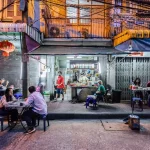
During the festival, food stalls throughout Phuket Town display a yellow flag with red Chinese characters. This is your signal that the stall is serving certified jay food for the duration of the festival. The flags go up on day one and come down on day nine. You do not need to speak Thai or Chinese to identify them — they are unmistakable.
Some dishes to look for at festival stalls:
- Jay pad thai — the stir-fried rice noodle dish made without egg or fish sauce, using soy-based seasoning instead. Lighter and slightly different in flavour to the standard version, but genuinely good.
- Tofu yellow curry — a thick, coconut-based curry using tofu and vegetables, fragrant with turmeric and lemongrass, without the shrimp paste that normally defines Thai curry bases.
- Mock roast duck — sliced wheat gluten with a crispy, slightly charred skin made from tofu skin. The texture is eerily convincing.
- Jay dim sum — steamed dumplings with mushroom and vegetable fillings, often sold from trays carried through the crowds near the main shrines.
- Taro desserts — sweet taro balls and coconut milk puddings that form the dessert backbone of the jay tradition.

One thing that surprises many visitors: Phuket Town’s regular restaurants do not all convert to jay menus. The yellow flags matter. Restaurants without the flag are operating as normal. This means you can eat jay one meal and standard Thai food the next without any confusion, as long as you watch for the flags.
How to Watch Responsibly
The festival is open to all observers, but it functions as a sincere religious event, not a performance for tourists. The crowds in 2026 will include devout Thai-Chinese families, Buddhist monks, and international visitors — and how you conduct yourself matters both practically and culturally.
Wear dark or subdued colours if possible, and definitely avoid red. Red is associated with bad luck in this Taoist context and is actively discouraged. White is the colour of purity and is worn by participants, so wearing white as an observer is also fine. What you should absolutely not wear is anything revealing — shorts above the knee, sleeveless tops, or beachwear. This applies to all genders. The shrines themselves require full coverage.
Photography is generally permitted during street processions, but the rules shift inside shrine compounds during active rituals. Ask before pointing a camera at devotees in preparation or recovery. Many mah song and their attendants will signal clearly if they do not want to be photographed. Respect that signal immediately. Using a flash near someone in a trance state is both rude and potentially dangerous.

The firecrackers are the most physically demanding aspect of attending. Bring earplugs — not optional, actual foam earplugs. Eye protection (sunglasses or sports glasses) protects against debris from the strings. After major detonations, the ground is carpeted in red paper shreds that make surfaces slippery. Watch your footing in crowds.
Do not touch the mah song, their equipment, or the offerings placed around shrine gates. These are active ritual objects. Attendants move through the crowd to manage space around the mah song — follow their direction without question. They are not there to manage tourist photo opportunities; they are managing the physical safety of someone in a trance.
The Street Procession Route and Key Temples
Phuket Town has five main shrines that serve as the organisational backbone of the festival. Each has its own community of devotees and its own mah song, and each shrine runs processions on different days of the nine-day calendar. Understanding which shrine does what on which day is the difference between an extraordinary experience and a confusing afternoon of waiting on empty streets.
The five principal shrines are:
- Jui Tui Shrine on Ranong Road — the largest and most visited, considered the spiritual centre of the festival. The processions originating here are the longest and most elaborate.
- Bang Niao Shrine on Thalang Road — particularly known for intense mah song piercing, with some of the most dramatic self-mortification visible during its procession days.
- Sapam Shrine in the Sapam community north of town — slightly harder to reach but draws serious observers for its more intimate scale.
- Sui Boon Tong Shrine — smaller, less crowded, and a better option for visitors who want to observe ceremonies without the full tourist press of Jui Tui.
- Cherng Talay Shrine in the north of the island — serves the Thalang community and runs its own independent schedule.

The procession routes wind through Phuket Town’s old quarter streets — Ranong Road, Yaowarat Road, Phang Nga Road, and Dibuk Road form the primary circuit. These streets are narrow even without crowds. During active processions, they become virtually impassable except at designated viewing points. Arriving at a corner on Dibuk Road thirty minutes before a procession is scheduled and watching the street fill with incense smoke, the distant crash of cymbals growing louder, and the first yellow-flag bearers appear around the corner — that moment is what draws people back to this festival year after year.
Each procession begins at the shrine early in the morning, often before dawn for the opening ceremonies, and the street component typically runs through mid-morning. The afternoon is generally quieter, with ritual activity returning to shrine interiors. Evening ceremonies at most shrines involve prayer chanting that visitors can observe respectfully from the edges of the courtyard.
2026 Budget Reality
The Vegetarian Festival drives accommodation prices up significantly across Phuket Town. Unlike the beach areas, where rates are less affected, guesthouses and boutique hotels in the old quarter run at a premium during the nine days. Book well in advance — by mid-2026, the best options in walking distance of the main shrines will already be full.
Accommodation
- Budget — fan-room guesthouses on the edges of the old quarter: 600–900 THB per night. Expect basic facilities, shared bathrooms in the cheapest options, and early morning noise from nearby shrines.
- Mid-range — air-conditioned rooms at heritage shophouse guesthouses and small boutique hotels: 1,500–2,800 THB per night. These fill fastest. The Sino-Portuguese building stock in the area means even mid-range properties have real character.
- Comfortable — boutique hotels with proper amenities within the old quarter or a short ride from it: 3,500–6,000 THB per night. At this tier you get air conditioning, reliable hot water, and staff who understand festival logistics.

Food
- Jay street food — 40–80 THB per dish at festival stalls. A full meal from multiple stalls will cost 150–250 THB.
- Jay restaurant meals — 180–350 THB for a sit-down meal with multiple dishes at a proper restaurant displaying the yellow flag.
- Non-jay meals outside the festival zone — standard Phuket Town prices apply: 80–200 THB for local Thai food.
Transport
- Grab rides from Phuket Airport to Phuket Town run approximately 350–500 THB in 2026, depending on time of day. Surge pricing during peak festival arrival days (the first weekend) pushes this toward 600–700 THB.
- Local songthaew (shared red trucks) around Phuket Town cost 30–50 THB per trip for short hops.
- Renting a scooter for the festival period: 250–400 THB per day, though parking near the shrine areas during procession days is genuinely difficult.
Planning Your Trip Around the Festival in 2026
The 2026 Phuket Vegetarian Festival runs from approximately 29 September to 7 October 2026, based on the ninth lunar month of the Chinese calendar. Confirm exact dates closer to the time, as the lunar calendar means the festival shifts slightly each year and official announcements come from the shrine committees.
Three days is the minimum stay that makes the journey worthwhile. Five days is ideal — it lets you experience at least two or three different shrine processions, gives you time to explore the old town and its food scene, and means you do not have to rush between ritual events. The first two days and the final day (when the Emperor Gods are sent back to heaven with a ceremony at the seafront) are the most significant moments to prioritise.

Getting to Phuket in 2026 is straightforward. Phuket International Airport connects directly to Bangkok (Suvarnabhumi and Don Mueang), Chiang Mai, and multiple international destinations. The 2025–2026 expansion of low-cost carrier routes has added more direct flights from regional hubs, making it easier to reach Phuket without routing through Bangkok. Flight time from Bangkok is approximately one hour. Return airfare from Bangkok to Phuket during the festival window will run 1,800–4,500 THB on budget carriers if booked early; prices climb steeply if you leave it until the month before.
One important practical note: if you are combining the festival with beach time, the rainy season is not entirely over by early October in Phuket. Expect afternoon rain, occasional heavy downpours, and high humidity. The ritual events still proceed in wet weather — firecrackers, processions, and ceremonies continue regardless — but walking the streets in rain gear while navigating festival crowds is its own experience. Pack a light rain jacket.
Phuket Town itself repays attention beyond the festival. The Sino-Portuguese shophouse architecture along Thalang Road and Dibuk Road is among the best-preserved colonial-era streetscapes in Southeast Asia. The old quarter’s coffee shops, independent boutiques, and weekend walking street market offer a version of Phuket that has nothing to do with Bangla Road. The festival is a reason to come; the town is a reason to stay.
Frequently Asked Questions
Is the Phuket Vegetarian Festival safe for tourists to attend?
Yes, but with practical preparation. The main hazards are physical: firecrackers cause serious noise damage without ear protection, and crowds near shrine gates can compress quickly. Stay aware of your surroundings during active processions, follow directions from shrine attendants, and wear closed shoes. The rituals themselves are not targeted at or dangerous to observers.

Do I have to eat only vegetarian food during the festival?
No. The jay diet is a spiritual practice for participating devotees, not a rule imposed on visitors. Non-jay food is available throughout Phuket Town and the broader island. However, trying the festival food from yellow-flag stalls is one of the genuine pleasures of attending — the jay cuisine is creative, flavourful, and unlike anything you find outside this context.
Can I visit the shrines as a non-Buddhist, non-Taoist foreigner?
Yes. The shrines are open to respectful visitors throughout the festival. Dress modestly — shoulders covered, knees covered — and remove shoes before entering shrine buildings. Do not touch offerings, ritual objects, or the mah song. Quiet observation is welcome; treat the space as you would any active place of worship.
What is the best day to visit if I can only attend once?
Day one (the opening ceremony, when the Emperor Gods are invited down) and day nine (the closing seafront ceremony) are the most spiritually significant. For the most dramatic street spectacle, the Jui Tui Shrine’s main procession day — typically around the middle of the nine days — draws the largest crowds and the greatest number of mah song. Check the shrine’s published schedule once it is released in September 2026.
How different is the 2026 festival from previous years?
The core rituals remain unchanged — these are centuries-old practices with deep community roots. What has shifted in recent years is crowd management: more barriers, clearer spectator zones, and tighter control near the most intense ritual moments. This makes the experience safer and somewhat more organised than it was a decade ago, though the intensity of the festival itself has not diminished.