On this page
- How Grab Works: Step-by-Step for First-Timers
- How to Use a Metered Taxi Without Getting Scammed
- 2026 Budget Reality: What Each Option Really Costs
- Safety: What Protects You in Each Option
- Convenience: Where Grab Wins and Where Taxis Win
- What Has Changed Since 2024
- When Neither Is the Best Choice
- Common Mistakes to Avoid
- Frequently Asked Questions
You land in Bangkok, walk out into the heat, and a driver offers a “special price” to your hotel. Two minutes later another taxi refuses to switch on the meter. This is still the most common Transport headache for visitors in 2026. The good news is that you have two solid options, Grab and the regular metered taxi, and each wins in different situations. Here is how both work, what they cost, and how to choose.
How Grab Works: Step-by-Step for First-Timers
Grab is the dominant ride-hailing app in Thailand. You can download it from the iOS App Store or Google Play Store. It works in Bangkok, Chiang Mai, Phuket, Pattaya, Hua Hin, Krabi, Samui, Hat Yai, and other cities and tourist areas. The official site is www.grab.com/th/.
The main ride types are:
- GrabCar: private sedans and SUVs with registered Grab drivers. The cars are usually newer, and the fare is fixed upfront.
- GrabTaxi: a regular metered taxi booked through the app. You pay the meter plus a booking fee.
- GrabBike: a motorcycle taxi for short trips through congested streets.
- GrabVan / GrabSUV: bigger vehicles for groups or lots of luggage.
Booking takes about a minute:
- Download Grab and register with your mobile number (Thai or international) and your email address.
- Let the app use your location, or set the pick-up point by hand.
- Type your destination. The app shows the route and distance.
- Choose your service: GrabCar, GrabTaxi, GrabBike, or a larger vehicle.
- Check the fare. GrabCar and GrabBike show a fixed price. GrabTaxi shows an estimated meter fare plus the booking fee.
- Tap “Book” to request a driver.
- Follow your driver on the map. You will see the name, photo, vehicle type, and licence plate.
- Pay at the end of the trip with your chosen method.
For payment you can use cash, a GrabPay wallet (topped up by bank transfer, card, or at convenience stores), or a linked Visa, Mastercard, JCB, or American Express card. You can also schedule a ride in advance, which helps for early flights.
How to Use a Metered Taxi Without Getting Scammed
Thai taxis come in many colours, including pink, green-yellow, blue, red-blue, and orange. The colour shows which cooperative or owner runs the car. All of them follow the same fare structure set by the Department of Land Transport (DLT, www.dlt.go.th). You can find them on the street, at taxi stands in airports and malls, or by phone through some cooperatives, though tourists rarely do that.

- Hail the right car. Wave at a taxi with the red “ว่าง” (waang, vacant) light on.
- State your destination. Show the address in Thai or on a map app. This avoids confusion.
- Ask for the meter. Say “Pai meter krap” (male) or “Pai meter ka” (female) before or just as you get in.
- Walk away if refused. A driver who insists on a fixed price is breaking the rules. Close the door and wave down another cab.
- Pay the meter plus tolls. Expressway and motorway tolls are the passenger’s cost.
Carry small notes (20, 50, and 100 THB). Drivers often cannot change a 500 or 1,000 THB note. Cards are extremely rare in taxis. Some newer fleets take Thai QR payments, but these are not reliable for tourists without a Thai bank account.
2026 Budget Reality: What Each Option Really Costs
Official metered fares start at 35 THB for the first kilometre. After that the rate rises with distance:
- 1-10 km: 5.50 THB/km
- 10-20 km: 6.50 THB/km
- 20-40 km: 7.50 THB/km
- 40-60 km: 8.50 THB/km
- 60-80 km: 9.00 THB/km
- Over 80 km: 10.50 THB/km
When the car crawls below 6 km/h, a traffic-jam charge of 3.00 THB per minute applies. Rides starting at Suvarnabhumi (BKK) or Don Mueang (DMK) carry a 50 THB airport surcharge.
GrabCar prices are dynamic. A typical base fare is about 40-50 THB, with roughly 8-12 THB per kilometre and 1.0-2.0 THB per minute. At busy times, bad weather, or high demand, surge pricing can raise the fare 1.5x to 3x or more. The app shows the surge price before you confirm.
Typical Fares Compared
- Short trip (5 km, 15 min): metered taxi about 70-100 THB; GrabCar 90-150 THB.
- Medium trip (15 km, 30 min): metered taxi about 180-250 THB; GrabCar 250-400 THB.
- Bangkok city centre to Suvarnabhumi (BKK): metered taxi 300-450 THB, including the 50 THB surcharge and tolls; GrabCar 450-700 THB, excluding tolls.
Budget Tiers for Getting Around Town

- Budget: BTS Skytrain (17-62 THB), MRT subway (17-45 THB), and shared songthaews on fixed routes (10-30 THB per person).
- Mid-range: metered taxis for short and medium trips (about 70-250 THB), or GrabCar for short hops (90-150 THB).
- Comfortable: GrabCar for medium trips and airport runs (250-700 THB), or GrabVan and GrabSUV when you have family or heavy bags.
The pattern is clear. An honest meter in light traffic usually beats GrabCar on price. Grab wins when the taxi would refuse the meter, since a fixed 300 THB taxi quote can cost more than the Grab fare you can see in the app.
Safety: What Protects You in Each Option
Grab has more built-in protection. Every ride is recorded with the driver’s name, photo, vehicle, and plate. You can share your trip with trusted contacts and watch the route in real time. An in-app emergency button connects you to local emergency services. Drivers and passengers rate each other, which encourages good behaviour, and support is available by in-app chat and phone. Grab says it runs background checks on drivers, but how often and how deeply it does so is not public, so treat that as one layer of safety and not a guarantee.
Regular taxis give you less. There is no tracking and no emergency button, and you cannot easily identify the driver. Risks include refused meters, longer routes, and inflated fixed prices aimed at tourists. If you leave a bag behind, getting it back is hard without driver contact details. Take a photo of the licence plate and the driver’s ID card, which is normally displayed in the cab, before you set off. It takes five seconds.
Convenience: Where Grab Wins and Where Taxis Win
Grab wins on convenience in several ways:
- Language: you type the destination, so you skip pronunciation problems.
- Door-to-door pick-up: the driver comes to the exact pin you set.
- Cashless: a linked card means no hunting for small notes.
- Pre-booking: useful for dawn airport transfers.
- Upfront price: you know the GrabCar fare before you commit.
Taxis win in other situations. You do not need data or a smartphone. On a main road such as Sukhumvit you can often have a cab within a minute.
Both have weak spots. Taxis can be hard to find in heavy rain or at rush hour, and drivers may refuse your destination. Grab can be slow to match during surge times, and pick-up points near airports and malls can take a few minutes to work out. Cars are easier to find in Bangkok, Phuket, and Pattaya than in smaller provincial towns, where Grab has expanded but coverage is less dense.

What Has Changed Since 2024
- Tighter ride-hailing rules: the government has kept refining regulations, aiming at clearer licensing for app-based drivers and vehicles. The result is more compliance and slightly stricter driver onboarding. Exact details can change, so check Grab’s Thailand site for current information.
- More Grab coverage: Grab has pushed into smaller provincial towns and resort areas.
- Contactless on the move: there is a push for direct EMV contactless acceptance by drivers with card terminals. It is not universal, so do not count on it.
- Taxi enforcement: the DLT has continued to crack down on meter refusal and overcharging, and penalties have been tightened. Enforcement is still inconsistent.
- Newer taxis: fleets are upgrading slowly, and some newer cars have better comfort and dashcams.
- Taxi OK app: the DLT has its own app, Taxi OK, but its use and reliability are well behind Grab.
- Tap-to-pay on trains: BTS and MRT accept EMV contactless Visa, Mastercard, and JCB cards directly at the turnstiles, rolled out from early 2025.
When Neither Is the Best Choice
In Bangkok, the trains often beat both. The BTS Skytrain (www.bts.co.th) and MRT subway (www.mrta.co.th) skip the traffic and connect at interchanges. BTS fares run 17-62 THB and MRT fares 17-45 THB. You can use a Rabbit Card for BTS, an MRT Plus Card for MRT, a single-journey ticket from the station machine, or your contactless bank card at the gate. Check the gate signage for the accepted card logos.
Outside Bangkok, other options matter:
- Songthaews: covered pickup trucks with two benches. Fixed routes cost about 10-30 THB per person, while chartered rides are negotiated.
- Tuk-tuks: fares are always negotiated first and are often high for tourists. They suit short distances and a bit of fun, not longer trips.
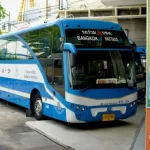
- VIP buses: air-conditioned coaches with wider seats connect Bangkok to Chiang Mai, Phuket, and Hat Yai. Buy tickets at terminals such as Mo Chit or the Southern Bus Terminal, or online through 12Go.Asia.
- Trains: the State Railway of Thailand (www.railway.co.th) runs routes from 3rd class to private 1st-class sleeper cabins. Book at stations or at www.dticket.railway.co.th, and book early for sleepers.
- Domestic flights: Thai AirAsia (www.airasia.com), Nok Air (www.nokair.com), and Thai Lion Air (www.lionairthai.com) are the budget carriers. Bangkok Airways (www.bangkokair.com) is a boutique airline with premium service to places like Samui, often at higher prices.
- Ferries and long-tail boats: ferries run from mainland ports such as Surat Thani and Krabi to the islands, operated by Lomprayah, Seatran, and Raja Ferry. Long-tail boats handle short hops and are priced per trip or per hour.

Common Mistakes to Avoid
- Accepting a “fixed price” taxi at the airport or tourist spot. Decline and take another cab, or switch to Grab.
- Forgetting tolls. Expressway tolls are added on top of the meter, and the GrabCar airport fare excludes them, so budget for them.
- Booking during a surge without checking. A 1.5x to 3x price can double a fare. Wait ten minutes, walk to a quieter street, or take the train.
- Mixing up GrabTaxi and GrabCar. GrabTaxi shows an estimate and adds a booking fee, plus a 50 THB airport surcharge from the airport. GrabCar shows a final fare.
- Skipping the plate check. Always match the licence plate and driver photo in Grab before you get in.
- Taking a car in rush hour when the BTS or MRT goes the same way. Trains avoid the traffic and cost far less.
As a simple rule: use Grab for airport runs, late nights, unfamiliar places, and any time you want a clear record of your ride. Use metered taxis for short, easy trips on busy streets, when you can insist on the meter. And in Bangkok, check whether the train gets you there first.
Frequently Asked Questions
Is Grab safer than a taxi in Thailand?
Generally yes. Grab gives you the driver’s name, photo, and plate, lets you share your ride with a contact, and has an in-app emergency button plus a two-way rating system. Metered taxis offer none of that. Most taxi rides are still uneventful, but Grab leaves a digital record if something goes wrong.
Is Grab cheaper than a taxi in Thailand?
Usually not. If the meter is used honestly and traffic is light, a metered taxi is often cheaper. A 15 km trip costs about 180-250 THB by taxi and 250-400 THB by GrabCar. Surge pricing of 1.5x to 3x can widen the gap during rain and rush hour.

Can I pay for Grab with cash in Thailand?
Yes. Grab accepts cash, a GrabPay wallet topped up by bank transfer, card, or convenience store, and linked Visa, Mastercard, JCB, or American Express cards. Cash works for most rides, but cards avoid change problems and let you skip carrying notes. Pick your payment method before you confirm the booking.
What should I do if a taxi driver refuses to use the meter?
Decline the ride and hail another taxi. Refusing the meter or demanding a fixed price is illegal for metered taxis. Say “Pai meter krap” (male) or “Pai meter ka” (female) before you get in. The DLT has tightened penalties, though enforcement is still inconsistent, so walking away is your best tool.
How much is a taxi or Grab from central Bangkok to Suvarnabhumi Airport?
A metered taxi costs about 300-450 THB, including the 50 THB airport surcharge and tolls. GrabCar costs about 450-700 THB, excluding tolls, with the airport surcharge built into the upfront fare. GrabTaxi adds a 50 THB airport surcharge on top of the meter plus the booking fee.
📷 Featured image by Manuel Bartsch on Unsplash.