On this page
- How Songthaews Work Outside Bangkok
- Moto Taxis: The Fastest Way Through Traffic
- Tuk-Tuks and Grab in Provincial Towns
- Long-Tail Boats and Island Ferries
- Between Provinces: Flights, VIP Buses, and SRT Trains
- 2026 Budget Reality
- What Has Changed Since 2024
- Language Basics
- Common Mistakes to Avoid
- Frequently Asked Questions
You land in a provincial town, walk out of the bus station, and realise there is no BTS, no MRT, and no obvious taxi rank. Many travellers in 2026 still expect the capital’s tidy rail network to appear everywhere, and they lose time and money when it doesn’t. Outside Bangkok, getting around runs on pick-up trucks, motorcycles, boats, and a handful of well-run long-distance services. Once you know how each one works, provincial Thailand is easy and cheap to navigate.
How Songthaews Work Outside Bangkok
A songthaew (“two benches”) is a pick-up truck with two rows of seats in the back and a canopy overhead. It is the shared bus and taxi of most provincial towns. You will hear the engine rattle, feel the warm breeze through the open sides, and smell the grilled pork smoke drifting from roadside stalls as you pass.
There are three ways songthaews operate:
- Semi-fixed routes: In larger towns such as Chiang Mai, Hua Hin, and Surat Thani, songthaews follow loose routes like a bus, picking up and dropping off passengers along the way.
- Flexible hailing: In smaller towns you can flag one down anywhere along a main road.
- Charter: You can hire the whole truck for a specific destination or a day trip.
How to ride one, step by step
- Hail it. Wave your hand as the songthaew approaches.
- Confirm the destination. On a fixed route, hop on if it is going in your general direction. For a specific place or an informal route, tell the driver where you want to go before you board. If the driver nods or signals agreement, get in.
- Agree the price if chartering. State your destination clearly and settle the price before the journey starts.
- Pay when you get off. Pay the driver, though some routes have a designated fare collector.
Shared fares in 2026 are projected at 10–40 THB per person for short trips within a town or district, and 40–80 THB for longer inter-district routes. A full charter typically costs 300–1,500 THB, depending on distance, time, and how the negotiation goes.
Moto Taxis: The Fastest Way Through Traffic
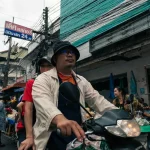
Moto taxi drivers wear coloured vests, often orange, pink, or green. You will find them at designated stands called “win-motorsai”, usually at street corners, markets, and near bus stations. You can also wave one down on the street. They are quick and efficient for short distances, especially when cars are crawling.
- Approach or hail. Walk to a stand or wave down a passing driver.
- State your destination and agree the price. Always settle the fare before you get on.
- Wear the helmet. The driver provides one. Enforcement of passenger helmet use remains a consistent focus.
- Pay on arrival.

Projected 2026 fares are 20–60 THB for short rides of 1–3 km and 50–100 THB for medium rides of 3–7 km. Longer distances are negotiable. Some drivers also work through GrabBike, which shows you the fare in the app before you commit.
Tuk-Tuks and Grab in Provincial Towns
Tuk-tuks are open-air, three-wheeled vehicles found mainly in tourist areas and larger provincial cities. They are built more for visitors than for locals’ daily commutes. You hail one from the street, and you must negotiate. Do not assume the driver will use a meter, because they almost never do. Short trips run about 50–150 THB and medium trips 100–300 THB. Longer distances and hourly charters are highly negotiable. Competition from Grab has influenced pricing in some areas.
Grab is the dominant ride-hailing app in Thailand. It is available on the iOS App Store and Google Play, and it is spreading to more provincial towns. The services include GrabCar, GrabBike, GrabTaxi, GrabSUV, and GrabVan. To use it:
- Download and register the Grab app.
- Enter your pickup and destination.
- Choose a service, such as GrabCar or GrabBike.
- Check the estimated fare and confirm.
- Pay with a linked credit or debit card, the GrabPay wallet, or cash to the driver.
Fares depend on distance, time, and demand, so surge pricing can apply. Base fares typically start at 40–60 THB, with total journeys ranging from 80–600 THB depending on distance and service type. Coverage in smaller towns can be thin, so have a backup plan. Other apps such as Bolt and inDriver exist in some areas, though availability varies.
Long-Tail Boats and Island Ferries
On the coast, transport means water. Long-tail boats are traditional wooden boats with a long propeller shaft trailing behind. At dawn the engine growl echoes across the pier while the smell of diesel mixes with salt air. They are essential for island hopping and for reaching remote beaches.
Head to the main pier or beach where the boats gather and tell the operator where you want to go. Confirm whether the trip is shared or private, and agree the price before boarding. Shared island shuttles run about 50–250 THB per person per trip. A private charter for a few hours costs 800–3,000 THB per boat, depending on duration, distance, and negotiation. Make sure life jackets are available and wear them, especially on longer crossings or in rough seas. The Marine Department reviews and enforces safety rules, particularly in Krabi and Phuket, and prices may rise slightly because of fuel costs.

For larger crossings, ferries link mainland ports and islands. Examples include Phuket to Phi Phi and Surat Thani to Koh Samui, Koh Phangan, and Koh Tao. Services range from slow car ferries to high-speed catamarans. The major operators are Lomprayah, Seatran Discovery, and Raja Ferry. You can book at the pier, through local travel agents, on operator websites (www.lomprayah.com, www.seatrandiscovery.com), or through 12go.asia. Fares are 200–1,200 THB per person. A high-speed ferry from Surat Thani to Koh Samui might cost 600–800 THB.
Between Provinces: Flights, VIP Buses, and SRT Trains
Local transport gets you around a town. To move between provinces, you have three main choices.
Domestic flights
Flying is the fastest option between major cities and tourist hubs. The main airlines are Thai AirAsia (www.airasia.com), Nok Air (www.nokair.com), Thai Lion Air (www.lionairthai.com), and Bangkok Airways (www.bangkokair.com). Bangkok Airways is a boutique airline that often costs more and includes lounge access. Economy one-way fares typically run 800–3,500 THB depending on route, booking time, and airline. Promotional fares can drop to around 500 THB. Routes continue to expand to secondary cities, and dynamic pricing is getting more sophisticated, so prices can shift quickly.
VIP buses
VIP buses are comfortable and affordable, especially overnight. Expect reclining seats, air conditioning, and sometimes snacks and water. Major operators include Nakhonchai Air, Sombat Tour, and Greenbus (mainly Northern Thailand). You can book at major terminals such as Bangkok’s Morchit, Southern, and Eastern Bus Terminals, or online through 12go.asia or operator sites like www.nakhonchaiair.com and www.sombattour.com. Fares run 200–1,200 THB depending on distance, class, and operator. A Bangkok to Chiang Mai VIP bus is around 600–900 THB. Online booking and e-ticketing are now standard.
State Railway of Thailand (SRT)
Trains are slower but scenic. Rattling past rice paddies at sunrise from a sleeper berth is one of the best parts of provincial travel. Use www.railway.co.th for general information and www.dticket.railway.co.th to book online.

- Ordinary/Rapid: The cheapest, often without A/C. Fares are 20–300 THB.
- Express/Special Express: Faster and more comfortable, often with A/C. Fares are 200–1,500 THB including surcharges.
- Sleeper, First Class: A private cabin for 1–2 people, 1,500–2,500 THB.
- Sleeper, Second Class: Upper and lower bunks, 700–1,200 THB, with A/C and fan options.
Sleepers run on longer routes such as North and South. Book ahead for sleepers and popular routes, either online or at the station.
2026 Budget Reality
These projected 2026 figures show what local transport costs at three spending levels.
Budget
- Songthaew within town: 10–40 THB per person
- Moto taxi, 1–3 km: 20–60 THB
- Shared long-tail island shuttle: 50–250 THB per person
- Ordinary/Rapid train: 20–300 THB
Mid-range
- Grab ride: 80–600 THB depending on distance and service
- Tuk-tuk, medium distance: 100–300 THB
- Bangkok to Chiang Mai VIP bus: 600–900 THB
- Surat Thani to Koh Samui high-speed ferry: 600–800 THB
- Second-class sleeper train: 700–1,200 THB
Comfortable
- Chartered songthaew for a day trip: 300–1,500 THB
- Private long-tail charter: 800–3,000 THB per boat
- First-class sleeper cabin: 1,500–2,500 THB
- Domestic economy flight: 800–3,500 THB one way
What Has Changed Since 2024
Songthaews and moto taxis have not changed in any fundamental way, and nothing major has been discontinued. What has changed is the digital layer around them.
- Digital payments and booking: Online booking and e-ticketing are now standard for buses, and the SRT online system keeps being refined. Digital payment options are more widely accepted across transport types.
- Songthaew apps: Some larger cities, such as Phuket and Chiang Mai, are reportedly adding songthaews to local transport apps for route tracking and fixed fares. Treat this as patchy and do not rely on it.
- Grab’s reach: Grab has expanded to more provincial towns, with more digital payment options and loyalty programmes.
- Rail upgrades: Double-tracking projects on major lines, including the Southern and Northern lines, are expected to improve efficiency and cut travel times by 2026. New rolling stock is also appearing on some routes. High-speed rail is still under development, and full inter-province operation to most major tourist destinations is not expected by 2026.
- Bus competition: Some bus routes may see changed frequency as domestic flights and improved SRT services compete.
- Ferries: Newer, larger, more environmentally friendly ferries are expected to keep arriving on popular routes.
- Bangkok: If your trip starts in the capital, the BTS and MRT have expanded significantly, and the Yellow Line and Pink Line are now operational and integrated. BTS fares are 17–65 THB and MRT fares 17–45 THB per journey. You can use a Rabbit Card on the BTS and an MRT Plus Card on the MRT. Contactless bank card acceptance at turnstiles is expected to be more widespread, and work continues on more seamless transfers between the two systems.

Language Basics
English works in major tourist areas, but in the provinces a few Thai words go a long way. Say “Pai [destination]?” to ask “Go to [destination]?” and “Tao rai?” to ask “How much?” Google Translate is a reliable backup for anything more complicated.
Common Mistakes to Avoid
- Agreeing the price after the ride starts. Settle it first with moto taxis, tuk-tuks, and charters.
- Expecting a tuk-tuk meter. They almost never use one.
- Skipping the helmet. Passenger helmet use is enforced, and it protects you.
- Assuming Grab is everywhere. Coverage is growing, but small towns can still have few drivers.
- Handing over big notes for small fares. Carry change.
- Leaving sleeper train booking to the last minute. Popular routes fill up, so book through dticket.railway.co.th or at the station.
- Boarding a boat without life jackets. Check before you leave the pier, especially in rough seas.
- Not telling a songthaew driver your destination. On informal routes, confirm before you climb in.
Frequently Asked Questions
How much does a songthaew cost in Thailand in 2026?
Shared songthaews are projected at 10–40 THB per person for short trips within a town or district, and 40–80 THB for longer inter-district routes. Chartering a whole truck typically costs 300–1,500 THB depending on distance, time, and negotiation. Pay the driver when you get off.
Do I need to negotiate with moto taxi drivers?
Yes. Always state your destination and agree the price before getting on. Projected fares are 20–60 THB for 1–3 km and 50–100 THB for 3–7 km. Longer distances are negotiable. If you want a fixed fare, a GrabBike booking shows the price in the app first.
Is Grab available outside Bangkok?
Grab is available in most major cities and increasingly in larger provincial towns, with services including GrabCar, GrabBike, and GrabTaxi. Coverage in smaller towns can be limited. You can pay by linked card, GrabPay, or cash. Other apps like Bolt and inDriver operate in some areas.
How do I book a sleeper train in Thailand?
Book through the State Railway of Thailand’s online portal at www.dticket.railway.co.th or at a train station. Booking ahead is recommended for sleepers and popular routes. First-class cabins cost about 1,500–2,500 THB and second-class bunks about 700–1,200 THB.
Can I pay for local transport by card in the provinces?
Mostly no. Songthaews, moto taxis, and long-tail boats usually take cash only, so carry small denominations. Grab accepts linked cards and GrabPay, and flights, VIP buses, ferries, and trains can be paid for through online booking systems. Keep cash for everything local.
📷 Featured image by Umpholphat Dangam on Unsplash.