On this page
- Planning a Trip to Thailand’s Ancient Capitals in 2026
- Ayutthaya Historical Park: Layout, Priorities, and What’s Actually Worth Your Time
- Sukhothai Historical Park: Three Zones, Slower Pace, and a Completely Different Feel
- Getting to Ayutthaya and Sukhothai from Bangkok
- Getting Around the Parks: Bicycles, Tuk-Tuks, and the 2026 Shuttle
- Where to Eat: Street Food, Night Markets, and Real Local Spots
- Where to Stay: Accommodation Areas and Budget Tiers
- Best Time to Visit: Heat, Rain, Festivals, and Realistic Expectations
- Combining Both Parks in One Trip: Practical Itineraries
- 2026 Practical Tips: Tickets, Dress Code, and What’s Changed
- Budget Breakdown: Daily Costs in THB for Both Destinations
- Frequently Asked Questions
💰 Click here to see Thailand Budget Breakdown
💰 Prices updated: October, 2026. Budget figures are estimates — always verify before travel.
Exchange Rate: $1 USD = ฿33.60
Daily Budget (per person)
Shoestring: ฿900.00 – ฿1,800.00 ($26.79 – $53.57)
Mid-range: ฿2,150.00 – ฿4,000.00 ($63.99 – $119.05)
Comfortable: ฿6,000.00 – ฿12,000.00 ($178.57 – $357.14)
Accommodation (per night)
Hostel/guesthouse: ฿90.00 – ฿750.00 ($2.68 – $22.32)
Mid-range hotel: ฿1,400.00 – ฿3,500.00 ($41.67 – $104.17)
Food (per meal)
Budget meal: ฿70.00 ($2.08)
Mid-range meal: ฿250.00 ($7.44)
Upscale meal: ฿1,000.00 ($29.76)
Transport
Single metro/bus trip: ฿30.00 ($0.89)
Monthly transport pass: ฿1,155.00 ($34.38)
Planning a Trip to Thailand’s Ancient Capitals in 2026
Thailand‘s two great historical park complexes — Ayutthaya and Sukhothai — have always attracted visitors. But in 2026, both sites face a genuine planning problem: overtourism at specific temples during peak morning hours, combined with heat that regularly pushes past 38°C between March and May. The Fine Arts Department also rolled out a unified digital ticketing system across both parks starting in late 2025, which means the old walk-up-and-pay approach at individual temples is mostly gone. If you show up without understanding the layout, you’ll spend half your day queuing or doubling back. This guide cuts through all of that — where to go, when to go, what to skip, and how to move between these two UNESCO World Heritage Sites without losing your mind or your budget.
Ayutthaya Historical Park: Layout, Priorities, and What’s Actually Worth Your Time
Ayutthaya was the capital of the Kingdom of Ayutthaya from 1351 to 1767, when Burmese forces sacked and burned it. What’s left is scattered across an island formed by three rivers — the Chao Phraya, Pa Sak, and Lopburi — plus some important temples on the outer banks. The island itself is only about 5 kilometres long and 2 kilometres wide, but the ruins are spread unevenly, so knowing the clusters matters.
The Central Island Temples
Wat Mahathat is the emotional core of the park. The famous Buddha head entwined in tree roots sits here, and the atmosphere in the early morning — golden light filtering through the banyan, the air thick with incense from a nearby shrine — is genuinely difficult to replicate anywhere else in Thailand. Get here before 8:00 am to experience it without the crowd pressing in from all sides. Entry is 50 THB per person.
Directly across the road, Wat Ratchaburana features two well-preserved prangs (towers) and a crypt that was looted decades ago but whose murals are partially intact. Most visitors skip it after Mahathat. That’s a mistake — the interior passage gives you a sense of the original scale and opulence that open-air ruins can’t convey. Entry is 50 THB.

Wat Phra Si Sanphet, the royal temple inside the former palace grounds, houses three iconic restored chedis in a row. This is the image you’ve seen on every Ayutthaya travel poster. Come at sunrise if you can — the chedis turn amber and rose against a pale sky, and it’s one of those moments that makes the early alarm worthwhile.
Outer Island Highlights
Wat Yai Chai Mongkhon, southeast of the island, is a working temple with an enormous reclining Buddha and a chedi you can climb (partially — there are steps inside the base). The compound is maintained by monks, which gives it a lived-in quality completely absent from the more touristy central sites. Entry is 20 THB.
Wat Phanan Choeng, on the Chao Phraya riverbank, houses a 19-metre seated Buddha that fills the entire interior of the viharn. The scale is staggering. Locals come here to pray, not just to sightsee, and the smell of jasmine garlands piled near the altar fills the hall. Entry is 20 THB.
What to skip on a short visit: Wat Lokayasutharam (a reclining Buddha in an open field — underwhelming without context), and Wat Thammikarat (charming but redundant if time is tight).

Sukhothai Historical Park: Three Zones, Slower Pace, and a Completely Different Feel
Sukhothai, the first capital of the Thai kingdom (established around 1238), has a fundamentally different atmosphere from Ayutthaya. Where Ayutthaya is dense, dramatic, and urban in feel — surrounded by a modern city — Sukhothai’s central zone sits inside a walled, largely forested park with lotus ponds, open lawns, and a pace that invites lingering rather than ticking off a checklist.
The park divides into three zones: Central, North (Wat Si Chum, Wat Phra Pai Luang), and West (Wat Saphan Hin, perched on a hill). Entry to the Central Zone is 100 THB for foreigners, plus 10 THB for bicycle hire if you rent inside the park. Each outer zone charges an additional 100 THB.
Central Zone: The Heart of the Park
Wat Mahathat Sukhothai is nothing like its Ayutthaya namesake. Here, rows of lotus-bud chedis reflect in wide, still ponds, and the main mondop (square-based tower) shelters a massive seated Buddha in the Sukhothai style — elongated features, flame-shaped ushnisha, and a serenity that the art historians call “walking Buddha” grace even in a seated form. Early morning here, with mist sitting on the water and kingfishers cutting across the surface, is one of the quietest, most grounding experiences in Thai heritage tourism.
Wat Si Sawai, with its three Khmer-style prangs, predates the Thai kingdom — it was originally a Hindu shrine. The contrast in architectural style within the same walled compound makes Sukhothai’s history feel layered in a way that a single-culture site can’t.
North and West Zones
Wat Si Chum in the North Zone houses a colossal seated Buddha — the Phra Achana — whose fingers alone are the height of a person. The image fills a narrow mondop almost completely, so the only way to photograph it is through a slit opening. The effect is theatrical in the best way. A secret passage inside the mondop’s walls leads upward; it’s partially accessible and contains faded jataka tale engravings.

Wat Saphan Hin in the West Zone requires a 15-minute walk or cycle uphill through forested terrain. The standing Buddha at the summit looks west across rice fields and distant hills. At dusk, this is the place to be in Sukhothai — not because the sunset is always spectacular, but because the silence and the view give you a moment to actually absorb what you’ve been looking at all day.
Getting to Ayutthaya and Sukhothai from Bangkok
To Ayutthaya
The cheapest and fastest option from Bangkok is the train from Hua Lamphong or Bang Sue Grand Station. Trains run frequently throughout the day; the journey takes between 1.5 and 2 hours and costs between 15 THB (3rd class) and 345 THB (2nd class air-conditioned). Ayutthaya train station sits just across the river from the historical island — a 10-THB ferry takes you across in under 5 minutes.
Minivans from Victory Monument in Bangkok depart regularly and cost around 60–80 THB, taking approximately 90 minutes to 2 hours depending on traffic. Note that the minivan drop-off is further from the historic centre than the train station.
To Sukhothai
Sukhothai doesn’t have a direct train connection from Bangkok. The most practical options are the overnight bus from Bangkok’s Mo Chit (Northern Bus Terminal), which takes around 6–7 hours and costs 350–550 THB, or a domestic flight to Sukhothai Airport (airport code THS). Bangkok Airways operates this route; fares in 2026 run from approximately 1,200–2,800 THB one-way depending on timing. The airport is only 27 kilometres from the historical park.
Between Ayutthaya and Sukhothai
There’s no direct connection. The most common route is Ayutthaya to Phitsanulok by train (3–4 hours, 60–200 THB), then a local bus or songthaew from Phitsanulok Bus Terminal to Sukhothai (1 hour, around 40–60 THB). Alternatively, a private transfer can be arranged through guesthouses for around 1,800–2,500 THB.

Getting Around the Parks: Bicycles, Tuk-Tuks, and the 2026 Shuttle
In Ayutthaya
Bicycles are the classic choice and still work well for the central island. Hire shops near the train station ferry landing charge 50–80 THB per day. The island roads are mostly flat, though midday heat between April and June makes cycling genuinely punishing. Tuk-tuks offer half-day tours for around 200–300 THB per person, and drivers typically know all the sites — agree on a route and a price upfront.
As of 2026, a new electric shuttle service operates on a fixed loop around the central island’s major sites. A day pass costs 120 THB and runs from 7:00 am to 5:00 pm. It doesn’t stop at off-island temples, but it solves the heat problem for those not wanting to cycle.
In Sukhothai
Bicycle hire inside the Central Zone entrance costs 30–50 THB per day. The park’s flat terrain and shaded paths make it genuinely pleasant outside of peak heat hours. For the North and West zones, which are separated by several kilometres, a rental bicycle or a tuk-tuk (around 150–200 THB for a loop of all three zones) is necessary. There is no electric shuttle equivalent in Sukhothai as of mid-2026, though local tourism authorities have proposed one for the 2026–2027 season.
Where to Eat: Street Food, Night Markets, and Real Local Spots
Ayutthaya
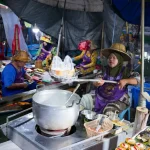
The night market along Chao Phrom Road, running parallel to the eastern edge of the island, is the best evening eating option. Open from around 5:00 pm, it stretches for several hundred metres with stalls selling boat noodles (kuaitiao ruea), grilled pork skewers, mango sticky rice, and fresh-pressed sugarcane juice. The boat noodle stalls along the Chao Phraya riverbank near the Bang Ian area are the ones locals point you toward — small bowls at 15–20 THB each, meant to be eaten in multiples.

For a sit-down meal, the cluster of restaurants on the western riverfront near Pridi Damrong Bridge serves excellent tom yum and grilled river prawns. Prices are higher than market stalls — expect 180–350 THB for a full plate — but the riverside setting as the temples glow across the water at dusk is genuinely pleasant.
The market at Hua Raw (on the north side of the island along the Lopburi River) opens from early morning and is where residents buy produce. The grilled river fish wrapped in banana leaves and the fresh coconut ice cream are worth the early start.
Sukhothai
New Sukhothai (the modern town 12 kilometres east of the historical park) has the best eating. The night market near the Yom River on Nikhon Kasem Road fills up after 5:00 pm with locals and travellers. Look for khao tom (rice porridge) stalls for breakfast, and the large pad thai and stir-fry stalls near the central market for lunch.
Sukhothai is specifically known for its local version of noodles — Sukhothai-style noodles (kuaitiao Sukhothai) are served in a slightly sweet pork broth with green beans and dried chilli, available at stalls near the historical park entrance and throughout the old town market for 50–70 THB per bowl.
Where to Stay: Accommodation Areas and Budget Tiers
Ayutthaya
The central island is the obvious base — walking distance to the main temples and close to the night market. Budget guesthouses here run 350–600 THB per night for a fan room with shared bathroom. The Chao Phrom Road and Naresuan Road area has the highest concentration of budget options.
Mid-range hotels cluster near the train station ferry and along the western riverfront, with river-view rooms typically running 900–1,800 THB per night. These offer air-conditioning, private bathrooms, and in some cases a small pool.

Luxury in Ayutthaya means boutique heritage properties, several of which have opened since 2023. Expect 3,500–6,500 THB per night for a genuine boutique experience with design that reflects the city’s historical character. The riverside boutique properties south of the island offer the quietest setting.
Sukhothai
You have two choices: stay near the Historical Park itself (convenient but limited options) or stay in New Sukhothai (more choice, 12 km from the park, requires transport each day). Near the park, budget guesthouses and small resorts charge 400–700 THB per night. Several of these are set in garden compounds that are genuinely peaceful in the evenings. Mid-range options near the park run 1,200–2,200 THB per night. New Sukhothai has the widest range, including some comfortable business hotels at 800–1,500 THB that suit travellers who value food access and transport links over proximity to ruins.
Best Time to Visit: Heat, Rain, Festivals, and Realistic Expectations
Both sites are outdoor experiences almost entirely. That makes weather the single most important planning variable.
November to February is the sweet spot. Temperatures sit between 20°C and 32°C, humidity is low, and skies are mostly clear. This is also when Loy Krathong falls (usually November), and Sukhothai’s celebration of this festival is nationally famous — candlelit floats on the temple ponds, fireworks, classical dance performances inside the historical park, and massive crowds. Book accommodation months ahead if you’re targeting the Loy Krathong weekend in Sukhothai.
March to May is brutal. Temperatures regularly reach 38–42°C, and visiting open-air sites between 10:00 am and 3:00 pm is genuinely uncomfortable and potentially dangerous for vulnerable travellers. If you must visit in this period, start before 7:30 am and stop by noon.

June to October brings rain — but not constant rain. Both Ayutthaya and Sukhothai are in the central plains, which receive less rainfall than the southern Gulf and Andaman coasts. Morning visits are often fine, with afternoon storms from August onward. Sukhothai’s ponds reflect the greenery especially beautifully in the rainy season, and crowds are thin. Ayutthaya has experienced some flooding in October–November due to its river-island geography; check water levels if visiting in this window.
Combining Both Parks in One Trip: Practical Itineraries
Most travellers who visit one want to see both, but underestimate the logistics. Here’s how to structure it without burning out.
2-Day trip (Ayutthaya only, day trip from Bangkok): Train from Bangkok, morning at Wat Mahathat and Ratchaburana, lunch at the riverside market, afternoon at Wat Phra Si Sanphet and Wat Yai Chai Mongkhon, evening train back. Comfortable and complete, though a night stay adds depth.
3-Day trip (Sukhothai focus with flight): Fly Bangkok to Sukhothai, two full days in the park (one for Central and North Zones, one for West Zone and the Ramkhamhaeng National Museum), fly back. The museum is worth 2 hours; its collection of Sukhothai-era Buddha images and Sukhothai script inscriptions contextualises everything you’ve walked through.
5-Day combined itinerary: Day 1 — Train to Ayutthaya, afternoon temples. Day 2 — Full day Ayutthaya. Day 3 — Train to Phitsanulok, bus to Sukhothai, afternoon park. Day 4 — Full day Sukhothai. Day 5 — Phitsanulok train back to Bangkok (Phitsanulok also has the Phra Buddha Chinnarat image at Wat Phra Si Rattana Mahathat — one of Thailand’s most revered Buddha images, worth a morning stop). This is the most logical and least rushed version of a combined trip.
2026 Practical Tips: Tickets, Dress Code, and What’s Changed
Dress code: Both parks enforce the standard temple dress code — shoulders and knees covered. Sarongs are available for hire at entry points (20–30 THB) if you arrive underprepared. The Fine Arts Department increased enforcement at Ayutthaya in mid-2025 after several incidents of disrespectful behaviour at Wat Mahathat; wardens now check at entry and will turn you back.

Ticketing: Ayutthaya now uses a unified digital pass. Sukhothai still sells tickets zone-by-zone at the gate, but a combined-park day pass (all three zones) was introduced in January 2026 for 220 THB. Individual zone tickets remain available at 100 THB each.
Photography at Wat Mahathat’s Buddha head: Posing with your head above the Buddha head (to appear taller than it) is explicitly prohibited and has been a diplomatic and cultural sensitivity issue. Wardens actively enforce this, and violations can result in fines under Thai cultural heritage law.
Heat management: Both parks have minimal shade in key areas. A wide-brim hat, sunscreen (minimum SPF 50), and a refillable water bottle are non-negotiable from February onward. Water refill stations were added to both parks’ central zones in 2025.
Scams: In Ayutthaya, be wary of tuk-tuk drivers who insist on taking you to a “special gemstone shop” or “government export warehouse” before your temple visit. This is a well-known scam. Agree on a temple-only route before you board.
Budget Breakdown: Daily Costs in THB for Both Destinations
Prices below reflect 2026 figures and cover a full day at each park.
Budget Tier (solo traveller, keeping costs low)
- Accommodation: 350–600 THB (guesthouse fan room)
- Park entry (all-access pass): 220 THB
- Bicycle hire: 50–80 THB
- Meals (3 meals, market and street stalls): 150–220 THB
- Transport within the day: 50–100 THB
- Daily total: approximately 820–1,220 THB
Mid-Range Tier
- Accommodation: 900–1,800 THB (air-conditioned hotel, private bathroom)
- Park entry: 220 THB
- Tuk-tuk or electric shuttle: 120–300 THB
- Meals (mix of sit-down restaurants and markets): 350–600 THB
- Incidentals (water, sunscreen, tips): 100–150 THB
- Daily total: approximately 1,690–3,070 THB

Comfortable Tier
- Accommodation: 3,500–6,500 THB (boutique heritage hotel)
- Park entry and guide: 220 THB entry + 800–1,500 THB for a licensed guide (half day)
- Private car or transfer: 600–1,200 THB
- Meals (riverside restaurants, full a-la-carte): 800–1,500 THB
- Daily total: approximately 5,920–10,700 THB
Transport between cities (Bangkok to Ayutthaya train, Ayutthaya to Sukhothai via Phitsanulok) adds roughly 300–600 THB at budget level or 2,500–4,000 THB if flying Bangkok–Sukhothai direct.
Frequently Asked Questions
Can you visit Ayutthaya and Sukhothai in one day?
No — not practically. The two cities are around 280 kilometres apart with no direct transport. Even if you flew, you’d have only a few hours at each site. Both parks deserve at least a full day each. A combined trip works best over 4–5 days, or as two separate day trips or short stays.
Is Ayutthaya worth an overnight stay, or is it just a day trip from Bangkok?
Overnight is worth it. The temples at sunrise and sunset look completely different from the midday version most day-trippers see. You also get access to the riverside night market without rushing back to Bangkok, and the off-island temples (Wat Yai Chai Mongkhon, Wat Phanan Choeng) are much easier to reach with a full day and morning.
Do I need a guide at either park?
Not essential, but meaningful. Both parks lack detailed on-site interpretation, and without context, the ruins can start to blur together. A licensed guide for a half-day costs 800–1,500 THB and makes the history genuinely engaging rather than a checklist exercise. Audio guides are available at Sukhothai’s central zone entrance for 50 THB.
What is the best time to visit Sukhothai for Loy Krathong?
Loy Krathong in Sukhothai falls on the full moon of the 12th Thai lunar month — usually in November. In 2026, this falls in early November. The festival runs for several days. The experience of watching candlelit floats on the historical park’s ponds surrounded by illuminated temples is extraordinary, but accommodation books out months in advance. Prices during festival week double or triple across all tiers.
Are the parks accessible for visitors with limited mobility?
Partially. Sukhothai’s Central Zone is largely flat and has wide paved paths, making it more accessible than most Thai heritage sites. The electric shuttle in Ayutthaya (introduced 2026) helps, but the Central Island terrain has uneven ground and steps at many temple sites. Neither park has comprehensive wheelchair infrastructure, though the main entry areas and visitor centres at both sites have accessible facilities.
Explore more
What to Buy in Thailand: The Ultimate Souvenir Guide
📷 Featured image by Yada Pongsirirushakun on Unsplash.