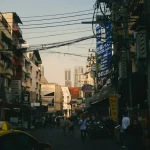
You land in Bangkok in 2026 with a translation app, a digital arrival card already filled in, and full confidence. Then a street vendor speaks fast, your phone has no signal, and the app turns “not spicy” into something else. Technology helps, but a handful of Thai Phrases fixes these small moments in seconds. This guide gives you the ones that matter most on a first trip, with simple pronunciation and the cultural context that makes them work.
Why Thai Tones Matter (and How to Survive Them)
Thai is a tonal language with five tones: mid, low, falling, high, and rising. The same syllable can mean different things depending on your pitch. The classic example is “mai,” which can mean “new,” “not,” “wood,” or “burn” depending on the tone.
This sounds scary, but first-time visitors don’t need perfect tones. Thais are used to foreigners and read your meaning from context, gestures, and the situation. If you say “khop khun” while handing over money, nobody will misunderstand you.
Here is a simple method. Listen to how locals say each phrase and copy the melody, not just the sounds. Say the phrase out loud a few times before you leave your hotel. A flat, robotic voice will be understood far more often than you expect.
Thai script is unique and looks impossible at first. You don’t need to read it. In tourist areas, most signs, menus, and transport announcements also have English. Spoken phrases are the useful skill here.
The First Five Phrases Every Traveler Needs
Start with these. They cover most polite interactions.
- Sawasdee krap / ka (sa-wat-dee krap / kah): Hello and goodbye. Men say “krap,” women say “ka.”
- Khop khun krap / ka (khawp-koon): Thank you.
- Chai (chai): Yes, “that’s correct.”
- Mai chai (my chai): No, “that’s not correct.”
- Kor thot krap / ka (kaw-toht): Excuse me / sorry.
The krap/ka rule is easy to remember. Your own gender decides the word, not the gender of the person you’re talking to. Adding it at the end of a sentence makes you sound polite. Leaving it off can sound blunt.
Pair “sawasdee” with a wai: palms pressed together near your chest and a slight bow of the head. You don’t need to wai everyone. A smile and a nod to a shop worker or driver is fine. Return a wai when someone gives you one, especially older people or monks.
Two more phrases are worth learning early. “Mai pen rai” (my pen rye) means “no problem” or “never mind,” and you’ll hear it everywhere. It reflects the calm, forgiving attitude Thais value. Use it to wave off small mix-ups, not serious problems.
Ordering Food Without Pointing
Picture a night market in Bangkok as the sun drops: a wok roars, chili smoke rises, and a vendor calls out orders in rapid Thai. This is where a few food phrases earn their place.
- Aroy (a-roy): Delicious. Say “aroy mak” (very delicious) and watch the vendor smile.
- Mai phet (my pet): Not spicy.
- Phet nit noi (pet nit noy): A little spicy.
- Mai sai phak chee (my sigh pak chee): No coriander.
- Ao an nee (ow an nee): I’ll have this one.
- Gep tang (gep tahng): Bill, please. “Check bin” also works.
“Mai phet” matters more than most travelers realize. Thai “a little spicy” can still be hot for a visitor. Som tum (green papaya salad) and larb (minced meat salad) are especially fiery, so say it early. If you want real heat, say “phet phet” (pet pet) and be ready.
Food allergies need more than a phrase. If you have a serious allergy, carry a printed Thai allergy card. Vendors may not understand every ingredient, and shrimp paste and fish sauce hide in many dishes.
Numbers, Prices, and 2026 Budget Reality
Knowing basic numbers lets you understand what you’re being charged. The key question is “tao rai?” (tao rye), meaning “how much?” Say it with “ni” (nee, this one): “Ni tao rai krap?”
- Neung (nung), 1
- Song (song), 2
- Sam (sahm), 3
- Si (see), 4
- Ha (hah), 5
- Hok (hok), 6
- Jet (jet), 7
- Paet (pate), 8
- Gao (gow), 9
- Sip (sip), 10
For 20 say “yi-sip,” for 100 say “neung roi” (nung roy). Prices are usually shown on signs, but at markets many vendors will show numbers on a calculator, which works fine too.
Here is what everyday things cost in Thailand in 2026, so you know when a price sounds fair:
- Budget: Street food plate 50–80 THB. Bottled water 10–15 THB. Songthaew (shared pickup taxi) 10–40 THB. BTS/MRT ride roughly 17–65 THB.
- Mid-range: Sit-down restaurant meal 150–350 THB. Café iced coffee 70–120 THB. Metered taxi across Bangkok 100–250 THB (the meter starts at 35 THB).
- Comfortable: Dinner at an upscale restaurant 600–1,500 THB. Private car with driver for a day 2,500–3,500 THB.
If a price feels high, say “phaeng pai” (paeng pie), meaning “too expensive,” with a smile. Follow with “lot noi dai mai?” (lot noy dai my), meaning “can you reduce it a little?” Bargaining works at markets and with tuk-tuk drivers, but not in malls, convenience stores, or restaurants with printed menus.
Getting Around and Asking for Directions
Transport is where Thai place words help most. The key phrase is “yoo tee nai?” (yoo tee nye), meaning “where is…?” Add the place after it: “Hong nam yoo tee nai?” (hong nahm yoo tee nye) means “Where is the toilet?”
- Liao sai (lee-ow sigh): Turn left.
- Liao kwa (lee-ow kwah): Turn right.
- Trong pai (trong pie): Go straight.
- Yut tee nee (yoot tee nee): Stop here.
- Pai… krap / ka (pie): I’m going to… Say it with your destination.
Bangkok’s rail network has grown a lot since 2024. The Yellow and Pink monorail lines now connect neighborhoods that once needed a long taxi ride, and stations and announcements use both Thai and English. You can ride most of the system without speaking at all. The Thai phrases matter more once you leave the rail lines, in songthaews, local buses, and smaller towns.
Drivers often don’t read English maps. Have your hotel’s name saved in Thai script on your phone, and show it when needed. That one screenshot saves more arguments than any phrase.
When Something Goes Wrong
Thais value staying calm and polite, so raising your voice almost never helps. Start with a gentle phrase and keep your tone soft.
- Mai khao jai (my cow jai): I don’t understand.
- Phut phasa Angkrit dai mai? (poot pah-sah ang-grit dai my): Can you speak English?
- Chuay duay! (chuay duay): Help!
- Tamruat (tam-ruat): Police.
- Rong phayaban (rong pa-yah-bahn): Hospital.
Shout “chuay duay” only in a real emergency. For serious situations in tourist areas, the Tourist Police line is 1155, and the national emergency number is 191. Thailand’s tourist police often speak English and are used to helping visitors.
For smaller problems, like a wrong order or a misunderstanding, “mai pen rai” and a smile resolve most things quickly. Losing your temper, by contrast, makes people lose face and tends to end the conversation.
Phrases vs. Apps in 2026
Translation tools are better than ever. Download the offline Thai pack in your translation app before you fly, and use the camera mode for menus and signs. Live conversation mode works well in a quiet hotel lobby.
But apps fail in the moments you need them most: weak signal on an island, a loud market, a driver who speaks quickly or uses slang. They also can’t do the social work. A spoken “sawasdee krap” and “khop khun ka” change how people treat you. Shop owners slow down, drivers relax, and prices often feel friendlier.
The best plan is both. Learn fifteen phrases, practice them on the flight, and keep your phone as backup.
Frequently Asked Questions
Can I get by in Thailand with only English?
Yes, in Bangkok, Phuket, Chiang Mai and other tourist areas, hotels, restaurants and tour operators use English daily. Outside those zones, English drops fast. Learning ten or fifteen Thai phrases helps with local markets, small guesthouses and taxi drivers, and people usually respond with warmer service and fairer prices.
Do I say krap or ka?
Men end polite sentences with krap, and women use ka. This applies to greetings, thanks and questions, no matter who you’re speaking to. Your gender decides the word, not the listener’s. Adding it makes you sound polite, and skipping it can sound abrupt or even rude.
Are Thai tones too hard for beginners?
Thai has five tones, and the same syllable can change meaning depending on pitch. Beginners shouldn’t panic. Context, gestures and a smile usually carry the message. Focus on a few phrases and listen closely to locals. Most Thais appreciate the effort even when your tones are off.
What is the most useful Thai phrase for tourists?
Khop khun krap/ka (thank you) is the most useful because you can use it hundreds of times. Close behind are tao rai (how much) and mai phet (not spicy). Together they cover shopping, eating and basic politeness, which is most of what a first-time visitor needs day to day.
Should I rely on translation apps instead of learning phrases?
Use apps as backup, not your main plan. Offline Thai packs and camera mode help with menus and signs. Still, learn core phrases because apps can fail with poor signal, noisy markets or slang. Spoken greetings and thanks also build goodwill that a phone screen cannot.
📷 Featured image by Road Ahead on Unsplash.