On this page
- The Short Answer: Match the Line to Your Destination
- BTS Skytrain: Lines, Hours and Fares
- MRT Subway: Lines, Hours and Fares
- How to Buy Tickets and Get Through the Gates
- Switching Between BTS and MRT
- What the Ride Actually Feels Like
- 2026 Budget Reality
- When Neither Train Is the Answer
- Common Mistakes to Avoid
- Frequently Asked Questions
You land in Bangkok, check your map, and see two rail networks with different colours, different tickets and different gates. Which one do you need? In 2026 the answer is easier than it used to be, because contactless card payments are spreading across both systems. But the two networks still do not share a fare system, and picking the wrong one for your destination can cost you time. This guide shows which system fits which trip, how to pay, and where people usually go wrong.
The Short Answer: Match the Line to Your Destination
Neither system is better overall. They cover different parts of the city, so your destination decides which one you use.
Use the BTS Skytrain for:
- Major shopping districts such as Siam and Chit Lom
- Entertainment areas such as Thong Lo and Ekkamai
- The Chao Phraya River, via Saphan Taksin station
Use the MRT Subway for:
- Cultural sites such as Hua Lamphong, and Sanam Chai for the Grand Palace and Wat Pho
- Business districts such as Si Lom and Sukhumvit
- The main bus terminal, via Chatuchak Park and Mo Chit
- Eastern and northern suburbs, thanks to the Yellow and Pink Lines
Fares are similar for similar distances, usually within 5 to 10 THB of each other. Most visitors end up using both in one day.
BTS Skytrain: Lines, Hours and Fares
The BTS is an elevated rail system with three lines:
- Sukhumvit Line (Light Green): Khu Khot in the north to Kheha in the south-east, passing Siam, Chit Lom, Asok and Ekkamai.
- Silom Line (Dark Green): National Stadium to Bang Wa, passing Siam, Sala Daeng and Saphan Taksin.
- Gold Line (automated people mover): Krung Thon Buri (on the Silom Line) to Khlong San and Iconsiam.
Trains run from about 06:00 to 00:00 daily. Expect a train every 3 to 5 minutes during peak hours (07:00 to 09:00 and 16:00 to 19:00) and every 5 to 8 minutes off-peak.
Single-journey fares on the Sukhumvit and Silom lines run from 17 THB to 62 THB for most trips, depending on distance. The Gold Line is a flat 16 THB.
MRT Subway: Lines, Hours and Fares
The MRT is part underground and part elevated. BEM operates the Blue and Purple lines, and the system has four lines:
- Blue Line (Chaloem Ratchamongkhon): A circular line covering Hua Lamphong, Si Lom, Sukhumvit, Chatuchak and Tha Phra.
- Purple Line (Chalong Ratchadham): Tao Poon (Blue Line) to Khlong Bang Phai, serving Nonthaburi province.
- Yellow Line (Lat Phrao-Samrong, monorail): Opened in 2023. It links Lat Phrao (Blue Line) with Samrong (BTS Sukhumvit Line) and serves eastern Bangkok.
- Pink Line (Kae Rai-Min Buri, monorail): Opened in late 2023 or early 2024. It links Min Buri with Nonthaburi Civic Center (Purple Line).

Operating hours are also about 06:00 to 00:00. Trains come every 3 to 7 minutes at peak times and every 6 to 10 minutes off-peak. Blue and Purple single trips cost 17 THB to 45 THB. The Yellow and Pink lines have their own fare structure, typically 15 THB to 45 THB.
How to Buy Tickets and Get Through the Gates
You have three ways to pay on either system. Here are the steps for each.
Option 1: Single-journey ticket
- Find a vending machine. Machines take coins and banknotes, and some newer BTS machines accept QR payments. Ticket booths work too.
- Select your destination or fare zone on the map.
- Pay the amount shown on the screen.
- On the BTS, use the paper ticket or QR code at the gate. On the MRT Blue and Purple lines you get an RFID token to tap on entry and drop in the slot on exit. The Yellow and Pink lines use QR code tickets.
Option 2: Stored-value card
- Go to any BTS ticket booth for a Rabbit Card, or any MRT ticket booth for an MRT Plus Card.
- Pay the card fee of about 100 THB (non-refundable) plus a minimum top-up of 100 THB.
- Tap in and out at the gates.
The Rabbit Card comes in Adult, Student and Senior types. It saves you from queuing for single tickets, gives slightly discounted fares on some routes, and works at selected merchants including McDonald’s, Starbucks and convenience stores. The MRT Plus Card gives seamless travel on the Blue and Purple lines.
Option 3: Contactless card or app
MRT has been a pioneer in EMV contactless payment, where you tap a credit or debit card directly at the gate. BTS is expected to follow, with wide acceptance by late 2025 or early 2026. Look for the contactless symbol on the gate before you rely on it, because rollout can vary by station.
For app tickets, M-Pass (operated by BEM) lets you buy a QR ticket and enter the gate on the Blue and Purple lines. The Yellow and Pink lines have their own QR ticketing apps or accept EMV payments. The BTS Skytrain app mainly gives route information and fare calculation. Buying a QR ticket and entering through the app is still limited, though expanding.
Switching Between BTS and MRT
This is where visitors get confused. The two main operators do not share fares. When you change from BTS to MRT, you exit one system and enter the other. That means a second ticket or tap and no combined fare calculation.
The main interchanges are:
- Asok (BTS) and Sukhumvit (MRT): the most common transfer for hotels and malls on Sukhumvit Road.
- Sala Daeng (BTS) and Si Lom (MRT): useful for the business district.
- Mo Chit (BTS) and Chatuchak Park (MRT): for the weekend market and the bus terminal.
- Siam: where the Sukhumvit and Silom BTS lines meet.
- Tao Poon: where the MRT Blue and Purple lines meet.
- Phetchaburi (MRT) and Makkasan (Airport Rail Link): for airport connections to Suvarnabhumi.
- Saphan Taksin (BTS): for the Chao Phraya Express Boat.
The Yellow Line is the exception to the separate-system rule in one sense. It physically connects BTS Samrong with MRT Lat Phrao. The Pink Line connects to the MRT Purple Line at Nonthaburi Civic Center. Neither system offers a unified day pass covering both BTS and MRT.
What the Ride Actually Feels Like
On the BTS, the experience is about the view. Around sunset you glide above Sukhumvit Road at rooftop height, with the neon signs flickering on and the traffic crawling far below. That alone makes a short Siam-to-Asok ride worth taking. The trade-off is crowds. At peak hours, carriages fill quickly.
The MRT is the opposite. You step off the street and out of the humid heat onto a cold, quiet platform where the air conditioning hits your skin and the noise of the city drops away. There are no views, but you also avoid traffic and weather completely.
On accessibility, all MRT stations have elevators and escalators. On the BTS, most stations have escalators, and newer stations and major interchanges have elevators for wheelchair access. If you travel with a wheelchair or heavy luggage, the MRT is the more reliable choice.

2026 Budget Reality
Rail is the cheapest way to cross Bangkok. These sample daily budgets use the 2026 fare ranges above.
- Budget (about 70 to 180 THB per day): Four rail trips at 17 THB to 45 THB each. Use single tickets or contactless tap, and stay on one line where you can.
- Mid-range (about 150 to 570 THB per day): Six rail trips at 17 THB to 45 THB, plus one tuk-tuk ride at 50 THB to 300 THB for a short hop or the experience.
- Comfortable (about 200 THB card start-up, then pay as you go): A Rabbit Card or MRT Plus Card (about 100 THB card fee plus 100 THB minimum top-up), with Grab for late nights or hot afternoons. Grab shows its fare upfront.
Longer BTS trips cost up to 62 THB, so a day with several long rides can cost more than these examples.
When Neither Train Is the Answer
Trains stop at about midnight and do not reach everywhere. For those gaps you have two main options.
Grab: Download the app on iOS or Android, register, enter your destination, choose a vehicle type and confirm the fare. GrabCar and GrabBike show a fixed price upfront. GrabTaxi uses the metered fare plus a booking fee. You can pay cash or link a card. It is usually cheaper and more transparent than negotiating with a street driver.
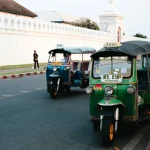
Tuk-tuks: They are fun for a short ride, and prices run from 50 THB to 300 THB. Always agree on the price before you get in, and be firm. They are often more expensive than Grab or metered taxis for the same distance. Stricter rules against overcharging have been introduced in some tourist areas since 2024, but negotiation is still the key.
Common Mistakes to Avoid
- Assuming one ticket covers both systems. It does not. Plan for two separate payments when you transfer.
- Relying on contactless without checking. Look for the contactless symbol at the gate before you tap. Rollout in 2026 is wide but not necessarily complete.
- Buying a card for a one-day visit. The 100 THB card fee is non-refundable.
- Travelling at peak hours without need. The BTS is very crowded 07:00 to 09:00 and 16:00 to 19:00.
- Missing the last train. Service ends around 00:00, so have the Grab app ready as a backup.
- Using the BTS for the Grand Palace area. The MRT (Sanam Chai) is the better fit for Grand Palace and Wat Pho.
Frequently Asked Questions
Is the BTS or MRT better for tourists in Bangkok?

It depends on where you are going. The BTS suits shopping areas like Siam and Chit Lom, plus Thong Lo and Ekkamai. The MRT is better for Hua Lamphong, Sanam Chai near the Grand Palace, Si Lom and Chatuchak. Most visitors use both, since fares are comparable.
Can I use one ticket for both the BTS and MRT?
No. The two main operators run separate fare systems. When you transfer, you leave one system and enter the other with a new ticket or tap. Neither system currently offers a unified day pass covering both, so plan for separate payments each time.
How much does a BTS or MRT ride cost in 2026?
BTS single journeys run from 17 THB to 62 THB on the Sukhumvit and Silom lines, and the Gold Line is a flat 16 THB. MRT Blue and Purple lines cost 17 THB to 45 THB. The Yellow and Pink lines are typically 15 THB to 45 THB.
Can I pay with my credit card at the gates?
Increasingly yes. The MRT has been a pioneer in contactless payment, and the Yellow and Pink lines support it too. The BTS is expected to accept contactless cards by late 2025 or early 2026. Check for the contactless symbol at the gate before relying on it.
What time do the BTS and MRT stop running?
Both run from about 06:00 to 00:00 daily. During peak hours the BTS comes every 3 to 5 minutes and the MRT every 3 to 7 minutes. Off-peak, expect 5 to 8 minutes on the BTS and 6 to 10 minutes on the MRT. Use Grab after midnight.
📷 Featured image by Non Chanon on Unsplash.