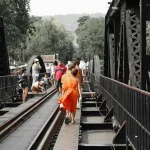
Thailand’s temples and sacred sites are busier than ever in 2026, and so is the scrutiny. Staff at major sites now turn away visitors at the gate for the wrong clothing, and locals regularly call out tourists who post disrespectful photos online. Knowing a few specific customs keeps your trip smooth and opens doors that stay closed to people who skip them.
The Wai and the “Cool Heart”
The wai is the Thai greeting: palms pressed together in front of the chest, with a slight bow. The higher your hands and the deeper your bow, the more respect you show. For friends and peers, hands sit at chest level. For elders, hands rise to the nose. For monks, they reach the forehead.
You do not need to wai everyone. Return a wai when an adult offers one. Hotel staff, shop assistants, and children usually do not receive one from visitors, so a smile and a nod work better. Say sawadee krap (men) or sawadee ka (women) as you greet.
Behind the wai is a bigger idea: jai yen, or “cool heart.” Thais value calm and avoid public conflict. Raising your voice or arguing in front of others makes you lose face, and it rarely gets you what you want. If a taxi fare or hotel bill goes wrong, lower your voice, smile, and keep talking. Mai pen rai (“never mind, it’s okay”) is not laziness. It is the habit of letting small problems go.
Two related customs matter in daily life. The head is considered the highest part of the body, so do not touch anyone’s head, including a child’s. Feet are the lowest, so do not point them at people or Buddha images, and do not use them to move objects.
Inside the Temple: Rules That Actually Get Enforced
Most visitors know to cover their shoulders and knees. Fewer know the details. Clothing should not be see-through, tight, or ripped. Hats and sunglasses come off inside the prayer hall. Shoes come off at the door, and so do socks at many temples.
Some rules are less obvious:
- Step over the raised wooden threshold at a temple door. Never on it. Tradition says a guardian spirit lives there.
- Sit with your feet tucked behind you or to the side, never pointing toward the Buddha image.
- Never climb on a Buddha statue or pose in a mocking way for a photo, even a joke pose. Selfies with your back to a Buddha image draw anger.
- Keep your voice low. Phones go on silent.
- Do not touch sacred objects, murals, or amulets without permission.

Monks, Alms, and Merit-Making
Buddhism shapes daily life across Thailand. Most Thai men spend some time as monks, and merit-making (tam bun) is part of regular routine. Giving food, donating, or releasing a bird or fish all count as ways to earn merit.
At sunrise, monks in saffron robes walk barefoot through neighborhoods collecting food in alms bowls. Locals kneel, remove their shoes, and place rice or packaged food into the bowl. It is quiet and moving, and visitors can take part if they do it correctly. Buy your offering from a vendor nearby, remove your shoes, keep your head lower than the monk’s, and stay silent. Do not stand over a monk with a camera or flash.
The key rule: women must not touch a monk, his robes, or hand him anything directly. A monk will lay a cloth down to receive an offering. If you are a woman, place the item on the cloth. On trains and buses, leave a seat or space beside him. On Bangkok’s BTS and MRT, seats near the doors are marked for monks.
Monk blessings, where a monk ties a white string around your wrist, are real religious acts. Accept the string with a wai and do not remove it for a few days if you can. A small donation is polite.
Respect for the Royal Family
Thais hold the monarchy in deep reverence, and the law backs it up. Under Section 112, lese-majeste, insulting or defaming the king, queen, heir, or regent can bring a prison sentence of three to fifteen years per offence. Courts apply this to online posts as well as spoken words, and to foreigners as well as citizens.
In daily life, this shows up in small ways:
- Portraits of the king appear in homes, shops, and streets. Do not deface or mock them.
- Thai banknotes and coins carry the king’s image. Do not step on a rolling coin to stop it. This is considered disrespectful.
- The national anthem plays in many public places at 8:00 and 18:00. People stand still. Do the same.
- Cinemas play a royal anthem before films. Everyone stands.

The practical rule is simple. Do not joke about, criticise, or debate the monarchy, in person or online, and do not ask Thais for their opinion either.
Sharing the Table
Thai meals are communal. Dishes arrive together and everyone shares, with rice as the base of each plate. You take a few spoonfuls of one dish onto your rice, eat some, then move to another. Piling your plate with one dish is considered greedy.
The main tools are a spoon and a fork. The spoon goes in your right hand and does the eating. The fork pushes food onto the spoon and does not go in your mouth. Chopsticks are used for noodle soups, and Thai rice is never stuck upright in a bowl, because it resembles incense offered to the dead. For sticky rice, use your right hand to roll small balls and dip.
If a host fills your plate, accept it. Leaving a little food on your plate tells the host you are full, so you do not need to clean it completely. Thais often use kreng jai (consideration), so a polite refusal can mean “yes, but offer again.” Offer a second time before you accept a “no.”
Tipping is not required. A service charge of about 10 percent is often added in restaurants. Small coins or notes are welcome for good service.
What Has Changed Since 2024
A few things look different in 2026 compared with two years ago:
- Digital arrival card: Thailand now requires an online Thailand Digital Arrival Card (TDAC) before you land. It is free, so avoid paid third-party sites that charge a fee.
- Cashless donations: More temples accept QR code payments for donations and entry, though cash in small notes still works everywhere.
- Dress code enforcement: Major sites in Bangkok, Chiang Mai, and Ayutthaya check clothing at entry more strictly, and online backlash against disrespectful behavior has grown.
- Easier Bangkok transport: The expanded BTS and MRT network, including the Pink and Yellow lines, makes it simpler to reach temples without taxis. Check alcohol sale rules around Buddhist holy days, since they have shifted in recent years.
2026 Budget Reality: What Cultural Experiences Cost
Many cultural experiences cost very little. Here is what to expect per day:
Budget (200–600 THB)
- Most local temples: free to 50 THB entry
- Offering sets (flowers, incense, candles): 20–100 THB
- Alms food from a market vendor: 30–100 THB
- Sarong or cover-up scarf: 100–300 THB
Mid-range (800–2,000 THB)
- Grand Palace entry: about 500 THB
- Traditional Thai massage: 300–600 THB per hour
- Half-day temple tour with a guide: 800–1,500 THB
- Thai cooking class: 1,000–1,800 THB
Comfortable (2,500–6,000 THB)
- Private cultural guide for a full day: 2,500–4,000 THB
- Village homestay with meals: 1,500–3,000 THB per night
- Private cooking or craft workshop: 2,000–3,500 THB
Prices vary by city and season. Bangkok and Phuket cost more, while smaller northern towns cost less.
Frequently Asked Questions
Do I have to wai back to everyone?
No. Return a wai from adults who greet you first. Do not wai children, and service staff usually get a smile and a nod. With monks, wai first, with hands higher near your nose. When unsure, a small nod with a smile is safe and never rude.
Can I wear shorts in Thai temples?
Not in most temples. Shoulders and knees must be covered, and tight or see-through clothing is refused. Active temples and the Grand Palace check at the gate. Carry a light scarf and thin long trousers or a wrap skirt in your day bag so you never get turned away.
Is tipping expected in Thailand?
Tipping is not required in Thailand. Many restaurants add a 10 percent service charge. For good service, leave 20–100 THB in coins or small notes. Taxi drivers appreciate rounding up to the nearest 10 THB, and massage therapists are usually tipped 50–100 THB.
Can women touch monks?
No. Thai monks avoid physical contact with women. Women should not hand items directly to a monk or brush against his robe. Place offerings on a cloth the monk puts down, or let a man pass them along. On public transport, leave space and do not sit beside a monk.
What is lese-majeste, and does it apply to tourists?
Lese-majeste, Section 112 of the criminal code, makes it a crime to defame, insult, or threaten the king, queen, heir, or regent, with penalties of three to fifteen years per offence. It applies to tourists and online posts. Avoid jokes, criticism, and damaging images of royals or royal money.
📷 Featured image by Barbara Maier on Unsplash.