On this page
- Southern Thai Flavors: What Makes Krabi Food Different
- Where to Eat: Best Street Food Spots and Markets
- Must-Try Dishes in Krabi
- Seafood in Krabi: Where to Find the Freshest Catch
- Krabi’s Best Food Courts and Local Restaurants
- Vegetarian and Vegan Eating in Krabi
- Krabi Coffee Culture and Drinks to Try
- 2026 Budget Breakdown for Eating in Krabi
- Practical Eating Tips for Krabi
- Frequently Asked Questions
💰 Click here to see Thailand Budget Breakdown
💰 Prices updated: October, 2026. Budget figures are estimates — always verify before travel.
Exchange Rate: $1 USD = ฿33.60
Daily Budget (per person)
Shoestring: ฿900.00 – ฿1,800.00 ($26.79 – $53.57)
Mid-range: ฿2,150.00 – ฿4,000.00 ($63.99 – $119.05)
Comfortable: ฿6,000.00 – ฿12,000.00 ($178.57 – $357.14)
Accommodation (per night)
Hostel/guesthouse: ฿90.00 – ฿750.00 ($2.68 – $22.32)
Mid-range hotel: ฿1,400.00 – ฿3,500.00 ($41.67 – $104.17)
Food (per meal)
Budget meal: ฿70.00 ($2.08)
Mid-range meal: ฿250.00 ($7.44)
Upscale meal: ฿1,000.00 ($29.76)
Transport
Single metro/bus trip: ฿30.00 ($0.89)
Monthly transport pass: ฿1,155.00 ($34.38)
Most travelers arrive in Krabi expecting beach food — overpriced seafood platters near Ao Nang, pad thai aimed at tourists, and nothing much beyond that. In 2026, that reputation is only half true. Yes, the beachfront restaurants exist. But behind them, and in the inland town of Krabi itself, there is a food scene that rewards anyone willing to walk a few blocks off the main drag. Southern Thai cuisine is genuinely different from what most visitors ate in Bangkok or Chiang Mai, and Krabi is one of the best places in Thailand to experience it without a guide, a food tour, or a reservation.
Southern Thai Flavors: What Makes Krabi Food Different
Southern Thai food is not just spicier — though it is. The cooking here carries distinct influences from the Malay peninsula, centuries of spice trading, and a coastline that has always shaped what ends up in the pot. Krabi sits in the heart of this tradition. The curries are darker and more intensely aromatic than central Thai versions. Turmeric appears in places you wouldn’t expect. Dried spices — coriander seed, cumin, cardamom — show up alongside fresh galangal and lemongrass.
The heat in southern Thai food is also different in character. It builds and stays with you rather than hitting and fading. Dishes like gaeng tai pla (fermented fish kidney curry) or khua kling (dry-fried minced meat with spice paste) are not for the faint-hearted, but they are some of the most complex and memorable flavors in the country. If you’ve been eating central Thai food all trip and think you know Thai cuisine, Krabi will correct that assumption quickly.
The ingredient base also reflects what grows and lives here. Coconut is everywhere — in curries, in desserts, in drinks. Fresh turmeric root colors rice and soups. Crab, shrimp, and fish come straight from the Andaman Sea. Betel leaf appears in snacks. Wild herbs you won’t find labeled in English make their way into soups and stir-fries at local restaurants.
Where to Eat: Best Street Food Spots and Markets
The most important thing to know about eating in Krabi is that the town itself — Krabi Town, about 5 kilometres inland from Ao Nang — is where the real food is. Most day-trippers never reach it. That’s your advantage.
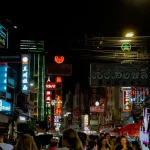
Krabi Town Walking Street (Soi Maharaj) runs on Friday, Saturday, and Sunday evenings from around 5 PM to 10 PM. The street fills with vendors selling local food — grilled satay, mango sticky rice, kanom jeen (rice noodles with curry), and fresh-squeezed juices. Smoke from charcoal grills hangs in the warm air as vendors fan flames and the smell of charred lemongrass drifts past. It’s genuinely local, affordable, and worth timing your visit around.
Talat Kao (the Old Market) near the Krabi River waterfront is the morning market that feeds the town. Arrive between 6 AM and 9 AM to find vendors selling kanom jeen with half a dozen curry options, fresh rotee with condensed milk and banana, and Muslim-style chicken rice (khao mok gai) that locals queue for. This is breakfast in Krabi, and it costs almost nothing.
Maharaj Market is the daily wet and fresh market where locals shop. It’s not a tourist destination, but walking through it gives you a clear picture of the regional ingredients — fresh turmeric, bundles of kaffir lime leaves, enormous dried shrimp, and live seafood in plastic tubs of seawater. Several cooked food stalls operate on the market’s edges from early morning through early afternoon.
Must-Try Dishes in Krabi
This is not a general list of Thai dishes. These are the plates you specifically need to eat while you are in Krabi, because they are done differently here and in some cases you will not find them done as well anywhere else in Thailand.
- Khua kling — dry-fried minced pork or beef with a deeply spiced southern paste, no sauce, eaten with rice. Every southern Thai cook has their own version. It’s fiery and aromatic in equal measure.
- Gaeng tai pla — a thick, pungent curry made with fermented fish innards, vegetables, and coconut milk. The smell is challenging but the flavor is extraordinary. Order it small the first time.
- Kanom jeen nam ya — thin rice noodles served with a fish-based curry sauce, topped with fresh herbs, bean sprouts, and hard-boiled egg. It’s the local breakfast of choice and available all day at many spots.
- Satay mu — pork satay grilled on charcoal, served with peanut sauce and pickled cucumber. The satay at the Walking Street market is consistently excellent, with char-edged meat and a peanut sauce that’s savory rather than sweet.
- Khao mok gai — Thai Muslim chicken rice cooked with turmeric and spices, served with a bowl of clear broth and cucumber relish. Far more subtle and fragrant than it sounds.
- Massaman curry — Krabi’s proximity to the Malaysian border means the Massaman here tends to be richer and more spiced than Bangkok versions, often made with fresh-butchered chicken or slow-cooked beef.
- Pad sator — stir-fried stink beans with shrimp paste and your choice of protein. Stink beans (sataw) are a polarizing ingredient — they taste faintly sulfurous raw but nutty and complex when cooked properly. Don’t miss them.
Seafood in Krabi: Where to Find the Freshest Catch
Krabi has access to Andaman Sea seafood that is genuinely excellent — the problem is knowing where to find it at fair prices. The beachfront restaurants in Ao Nang charge two to three times more than town restaurants for equivalent quality, and the produce is often the same.
The Krabi Town waterfront along the river has several seafood restaurants that cater mostly to Thai visitors and locals. These are the spots to look for. Order grilled sea bass with lemongrass, stir-fried crab with yellow curry powder and egg, or a simple steamed fish with lime and chili sauce. Prawns from the Andaman are fat and sweet — order them simply grilled or in a clear sour broth (tom yam) rather than drowned in sauce.
Ao Nang’s Night Market, which runs nightly along the main beach road, has a section of seafood vendors where you can select raw fish, crabs, and shellfish by weight and have them cooked to order. It’s touristy in atmosphere but the seafood quality is good and prices are more reasonable than the sit-down restaurants nearby. A whole grilled fish with papaya salad and rice for two people costs around 350–500 THB here in 2026.
On Koh Lanta and during day trips to the islands, seafood quality varies. The best rule is to look for restaurants where Thai fishermen are also eating, or where the menu is handwritten on a board rather than laminated and illustrated with photos.
Krabi’s Best Food Courts and Local Restaurants
Beyond markets and street stalls, Krabi Town has a cluster of reliable local restaurants that punch well above their price point.
May and Mark Restaurant on Chao Fa Road in Krabi Town has been recommended consistently since the early 2020s and remains one of the most trusted spots for southern Thai curries in 2026. The kaeng lueang (yellow curry) with freshwater fish is a house specialty. No frills, simple seating, food that tastes like someone’s home kitchen.
Koktail Restaurant near the waterfront handles both Thai food and fresh seafood without the tourist markup. It’s a good transitional spot if you are nervous about navigating Thai-only menus.
For food courts, the Big C and Tesco Lotus branches in Krabi Town both have air-conditioned food courts on their upper floors with reliable, cheap versions of Thai standards — mostly aimed at locals, which keeps the quality honest. A full plate of food here runs 50–80 THB.
Vegetarian and Vegan Eating in Krabi
Southern Thai cuisine is heavily meat and fish-based, but Krabi is more vegetarian-friendly than the cuisine would suggest. The town has a Chinese-Thai community with deep roots, and the annual Vegetarian Festival in October means many restaurants have experience preparing jay food (Thai Buddhist vegetarian food, which excludes meat, fish, garlic, and onion).
Year-round, several spots in Krabi Town serve vegetarian food explicitly. Look for the yellow flag with red Chinese characters — this signals a jay food restaurant or stall. During the Vegetarian Festival, these flags appear everywhere and the food is exceptionally good and cheap.
Beyond festival season, Ao Nang has a handful of genuinely good vegan cafes, driven by the large number of international visitors. Spots along the Ao Nang beachfront and the backpacker-oriented streets behind it serve smoothie bowls, vegan curries, and Western-style breakfasts for those who need a break from the spice.
When ordering at regular restaurants, asking for jay (เจ) or mangsawirat (มังสวิรัต) will communicate your needs. Be aware that many Thai dishes are made with shrimp paste or fish sauce as a base, even when they appear vegetarian. Stating “mai sai nam pla, mai sai kapi” (no fish sauce, no shrimp paste) is the clearest way to communicate your requirements.
Krabi Coffee Culture and Drinks to Try
Krabi has a growing café scene that reflects both local habits and the influence of tourism. Thai-style iced coffee (kafae yen) remains the local drink of choice — strong robusta coffee brewed through a cloth filter sock, poured over ice, and mixed with sweetened condensed milk. It’s intensely sweet and caffeine-loaded, available at nearly every market stall for 20–35 THB.
The town’s independent café scene has expanded noticeably since 2024. A cluster of specialty coffee shops has opened near the Chao Fa Pier area and along Uttarakit Road, serving single-origin Thai arabica beans from Chiang Rai and Doi Inthanon. These cater to a younger Thai crowd as much as tourists, and are genuinely good by any standard — expect to pay 80–120 THB for a properly made flat white or pour-over.
For non-coffee drinks, try:
- Nam manao — fresh lime juice with sugar and salt. The salt is essential and transforms the drink entirely. Ask for it not-sweet (wan noi) if you prefer.
- Coconut water — young coconuts cracked open at market stalls. Served cold, this is the best hydration you’ll find in 35-degree heat.
- Oliang — traditional Thai iced black coffee with corn, sesame, and soybeans roasted in. Much earthier and more complex than standard coffee.
- Fresh sugarcane juice — pressed on the spot at market stalls, slightly grassy and very refreshing.
2026 Budget Breakdown for Eating in Krabi
Food costs in Krabi in 2026 vary enormously based on where you eat. The good news is that eating well on a tight budget is entirely possible as long as you get off the tourist strip.
Budget Eating (under 200 THB per meal)
- Market stalls and street food: 40–80 THB per dish
- Kanom jeen breakfast with curry: 40–60 THB
- Local restaurant rice and curry plates: 70–120 THB
- Food court meals: 50–90 THB
- Fresh fruit from market vendors: 20–40 THB per bag
Mid-Range Eating (200–600 THB per meal)
- Seafood restaurants in Krabi Town: 200–400 THB per person with a drink
- Ao Nang night market seafood: 150–300 THB per person
- Local Thai restaurants with English menus: 120–200 THB per dish
- Specialty coffee cafes: 80–150 THB per drink
Comfortable/Tourist Eating (600 THB+ per meal)
- Beachfront Ao Nang restaurants: 300–600 THB per main dish
- Hotel restaurants: 400–800 THB per person
- Island resort dining (Phi Phi, Railay): 400–900 THB per meal
- Western-style cafes and brunch spots: 200–350 THB per dish
A realistic daily food budget eating mostly local food is 300–500 THB per day. Eating exclusively at tourist restaurants, you could easily spend 1,500–2,500 THB or more per day on food alone.
Practical Eating Tips for Krabi
Spice levels are serious. When a local restaurant says something is spicy, believe them. Southern Thai spicy is categorically different from tourist spicy. If you want to try dishes like khua kling or gaeng tai pla, ask for a small portion first. There is no shame in this and staff will respect the caution.
Eat where Thais eat. The presence of Thai customers — especially Thai families — is the single most reliable indicator of food quality and fair pricing. Empty restaurants at meal times are always a warning sign.
Carry small cash. Most street stalls and markets operate cash only. In 2026, QR code payments (PromptPay) are widely used at local restaurants in Krabi Town but less common at market stalls. ATMs are plentiful in Ao Nang and Krabi Town.
Timing matters. The best street food and market stalls sell out by mid-morning (breakfast spots) or by 9 PM (dinner stalls). Arriving late means limited choice. The Krabi Town Walking Street is best visited by 6 PM before the most popular vendors sell out.
Water and hygiene. Drink bottled or filtered water — tap water is not safe to drink in Krabi. Ice at established restaurants and markets is made from purified water and is generally safe. Ice delivered by roadside vendors (cylindrical tubes) is also safe. Avoid ice that looks like crushed block ice at very basic stalls.
Allergies. Peanuts appear frequently in southern Thai cooking, as does shrimp paste. If you have severe allergies, communicate clearly and consider carrying a Thai-language allergy card — these are available as printable downloads from several travel websites and are taken seriously by restaurant staff.
Frequently Asked Questions
What is the most famous food in Krabi?
Krabi is best known for southern Thai dishes like khua kling (dry-fried spiced minced meat), kanom jeen (rice noodles with curry), and fresh Andaman seafood. Massaman curry is also done very well here due to Krabi’s proximity to the Malaysian border, with richer spicing than you find in Bangkok.
Is food in Krabi expensive compared to Bangkok?
Street food and local restaurants in Krabi are comparable to Bangkok in price — around 50–120 THB per dish. However, tourist-facing restaurants in Ao Nang and on the islands charge significantly more. Eating in Krabi Town rather than Ao Nang consistently saves money without sacrificing quality.
Where is the best place to eat street food in Krabi?
The Krabi Town Walking Street (Soi Maharaj) on Friday, Saturday, and Sunday evenings is the top street food destination. For daily options, Talat Kao near the river is excellent for breakfast, and Maharaj Market has cooked food stalls throughout the morning and early afternoon.
Is it safe to eat street food in Krabi?
Yes, in general. Apply the same logic you would anywhere in Thailand — eat at stalls with high turnover, food cooked fresh to order, and visible cleanliness. Markets and walking street stalls in Krabi Town are considered safe by most travelers in 2026. Avoid pre-cooked food sitting out for long periods in the heat.
Can vegetarians eat well in Krabi?
Yes, more easily than you might expect in a southern Thai destination. Jay food stalls marked with yellow flags exist in Krabi Town year-round. Ao Nang also has several dedicated vegan and vegetarian cafes. At regular restaurants, specify “mai sai nam pla, mai sai kapi” (no fish sauce, no shrimp paste) to get the closest thing to a truly vegetarian dish.
📷 Featured image by Tom Lorber on Unsplash.