On this page
- What Makes Kanchanaburi Different From Other Thai Destinations
- The Death Railway & WWII History You Need to Understand First
- Erawan National Park — How to Visit Without the Chaos
- Beyond Erawan — Nature Reserves, Rivers & Waterfalls Most Visitors Skip
- Where to Eat in Kanchanaburi
- Day Trip or Overnight? Making the Right Call
- Getting to Kanchanaburi & Getting Around
- 2026 Budget Reality — What Everything Costs
- Practical Tips Before You Go
- Frequently Asked Questions
💰 Click here to see Thailand Budget Breakdown
💰 Prices updated: October, 2026. Budget figures are estimates — always verify before travel.
Exchange Rate: $1 USD = ฿33.60
Daily Budget (per person)
Shoestring: ฿900.00 – ฿1,800.00 ($26.79 – $53.57)
Mid-range: ฿2,150.00 – ฿4,000.00 ($63.99 – $119.05)
Comfortable: ฿6,000.00 – ฿12,000.00 ($178.57 – $357.14)
Accommodation (per night)
Hostel/guesthouse: ฿90.00 – ฿750.00 ($2.68 – $22.32)
Mid-range hotel: ฿1,400.00 – ฿3,500.00 ($41.67 – $104.17)
Food (per meal)
Budget meal: ฿70.00 ($2.08)
Mid-range meal: ฿250.00 ($7.44)
Upscale meal: ฿1,000.00 ($29.76)
Transport
Single metro/bus trip: ฿30.00 ($0.89)
Monthly transport pass: ฿1,155.00 ($34.38)
Kanchanaburi has been drawing visitors for decades — the Death Railway, Erawan Falls, the River Kwai — but 2026 has brought some real friction to the experience. The national park authority now enforces strict daily visitor caps at Erawan, online pre-booking is mandatory on weekends and public holidays, and prices for accommodation have climbed noticeably since the post-pandemic boom years. If you show up without a plan, you may find Erawan’s tickets sold out and the town’s guesthouses full. This guide helps you avoid that and get the most out of one of Thailand’s most genuinely compelling destinations.
What Makes Kanchanaburi Different From Other Thai Destinations
Most Thai provinces sell you one thing — beach, temples, or mountains. Kanchanaburi sells you three things at once, and they fit together in a way that doesn’t feel forced. You have serious WWII history layered on top of dramatic river landscapes, which sit next to some of the densest forest in western Thailand. The province shares a border with Myanmar, and that geography means the terrain here is genuinely wild — not manicured wild, but frontier wild.
The town itself sits at the confluence of the Kwai Noi and Kwai Yai rivers. In the late afternoon, when the light turns amber and long-tail boats cut through the water past bamboo raft houses, the place has a quietness that’s hard to find in Thailand’s more visited destinations. It isn’t Chiang Mai-polished or Phuket-buzzy. It still operates mostly for Thais from Bangkok who drive up on weekends, which keeps the character authentic even as foreign tourism grows.
The Death Railway & WWII History You Need to Understand First
The historical weight of Kanchanaburi is not decoration. During World War II, the Japanese Imperial Army forced approximately 180,000 Asian labourers and 60,000 Allied prisoners of war to build a railway through jungle and mountain terrain connecting Thailand to Burma. More than 90,000 people died in the process. The phrase “Death Railway” is not hyperbole.
Before you visit anything else, spend a morning at the Thailand-Burma Railway Centre on Jaokannun Road in town. This is a private museum, not government-run, and the quality of its exhibits surpasses anything else in Kanchanaburi. The research is rigorous, the displays include individual prisoner accounts, and it contextualises the full scope of what happened in a way that the nearby Allied War Cemetery alone cannot. Entry in 2026 is around 200 THB.
The Allied War Cemetery, maintained by the Commonwealth War Graves Commission, is directly across the road. Over 6,900 graves are arranged in a long, immaculate garden. The silence there in the early morning, broken only by birdsong and the occasional murmur from a passing tuk-tuk on the road outside, is genuinely sobering. Admission is free.
The famous Bridge on the River Kwai is worth seeing but temper your expectations — it’s shorter and less dramatic than film mythology suggests. The best experience is crossing it on foot, then catching the Death Railway train from Kanchanaburi station toward Nam Tok. The stretch between Wang Po viaduct and the river below is where the engineering audacity of the route becomes viscerally clear.
Erawan National Park — How to Visit Without the Chaos
Erawan’s seven-tiered waterfall system is the reason most foreign visitors come to Kanchanaburi, and on a weekday in the dry season it absolutely earns its reputation. The water is a pale turquoise-green that looks unreal, small fish nibble at your feet in the lower pools, and the forest canopy keeps the heat manageable. On a Saturday in March, however, it’s shoulder-to-shoulder crowds and queues at the trail junctions.
The practical rules for 2026: entry to Erawan National Park costs 300 THB for foreign adults, down from the 400 THB introduced briefly in late 2024 after public backlash. On weekends and Thai public holidays, you must book through the national park’s online system at least one day in advance — the daily foreign visitor quota fills within hours of release. Weekday visits currently don’t require pre-booking but check the DNP (Department of National Parks) app before you go, as this policy has been updated mid-season before.
Tiers one through three are accessible and often crowded. Tiers five, six, and seven require actual effort — uneven stone steps, rope-assist sections, and 30 minutes of uphill walking. Most visitors turn back at tier three, which means the upper tiers offer real solitude. Tier seven, particularly, is worth every step: a narrow curtain of water dropping into a clear green pool with almost nobody around.
Get there when the park opens at 08:00. The light through the forest at that hour is extraordinary — shafts of gold cutting through the mist above the lower pools, the sound of the falls amplified in the morning quiet before the midday crowds arrive.
Beyond Erawan — Nature Reserves, Rivers & Waterfalls Most Visitors Skip
Sai Yok National Park, about 100 kilometres northwest of Kanchanaburi town along Route 323, contains Sai Yok Noi and Sai Yok Yai waterfalls, both dropping directly into the Kwai Noi river. You can combine them with a section of original Death Railway track that runs through the park. The Hellfire Pass Memorial, located near the Konyu Cutting, is one of the most important WWII sites in the region and is managed by the Australian government — free entry, excellent audio guide available.
Huai Kha Khaeng Wildlife Sanctuary borders the province to the north and is a UNESCO World Heritage Site. Access is restricted and requires advance permits, but for anyone serious about wildlife — tigers, elephants, gaur, and extraordinary birdlife exist here in numbers that have recovered significantly since 2020 — it’s worth the paperwork.
For a low-effort river experience close to town, the raft houses on the Kwai Yai river offer overnight stays on floating bamboo platforms. Waking up with the river running beneath you, the forest on both banks still in morning mist, is a sensory experience specific to Kanchanaburi that no beach hotel in Thailand replicates.
Where to Eat in Kanchanaburi
The food scene in Kanchanaburi is deeply Thai-central, with Mon and Karen influences that show up in dishes you won’t commonly find in Bangkok. Aree Bakery on Saeng Chuto Road is a local institution for breakfast — jok (rice porridge) and Chinese-style doughnuts in the early morning, followed by filter coffee that’s genuinely good.
For lunch and dinner, the night market that sets up along the river near the Chao Phraya Road junction is your best bet for variety and price. Look for tom yum fish made with fresh river catch, and the Mon-style fermented fish curry that has a depth and sourness quite different from central Thai cooking.
Schluck, a small bar and restaurant near the war cemetery popular with expats and long-term visitors, does solid Thai food alongside cold draught beer and is a reliable evening option. For something more upscale, the restaurants attached to floating raft houses on the river charge more but offer a setting — dinner on the water, soft lights, occasional longtail passing — that’s genuinely memorable.
Day Trip or Overnight? Making the Right Call
Kanchanaburi is 130 kilometres from Bangkok, roughly two to three hours by road depending on traffic. It’s technically a day trip — Bangkok tour operators run them constantly. But a single day forces you to choose between the history and the nature, and you’ll do neither properly.
If you have one day: Focus on the WWII sites in the morning (museum, cemetery, bridge) and take the afternoon train toward Nam Tok. Skip Erawan unless you’re arriving very early and have transport sorted.
If you have two days: Erawan on day one (arrive at opening), river and town on day two. Add Hellfire Pass if you have a vehicle.
If you have three or more days: Use Kanchanaburi as a base to explore Sai Yok, consider a raft house night, and take a slow morning on the river before heading back.
The overnight decision is easy if you’ve come from Bangkok: accommodation is affordable, the town is pleasant in the evening, and you simply cannot do Erawan justice as part of a rushed day trip from the capital.
Getting to Kanchanaburi & Getting Around
From Bangkok by bus: Direct buses depart from Bangkok’s Southern Bus Terminal (Sai Tai Mai) roughly every 30 minutes throughout the day. Journey time is two to two-and-a-half hours, fare around 120–140 THB. This is the most practical option for independent travellers.
By train: The State Railway runs trains from Bangkok Thonburi station (not Hua Lamphong) to Kanchanaburi. The journey takes about three hours and the fare is under 100 THB, but departures are limited — check the SRT app for current timetables, as the 2025 schedule revision changed departure times.
By private car or hired vehicle: Driving gives you the most flexibility for Sai Yok and Hellfire Pass. Car rental from Bangkok agencies starts around 1,200–1,500 THB per day. Traffic leaving Bangkok on Friday evenings is brutal — leave before 14:00 or after 20:00.
Getting around locally: Songthaews (shared pickup trucks) connect the town to Erawan National Park — roughly 60 THB per person each way. For more flexibility, hire a motorbike from town (around 250–300 THB per day). Tuk-tuks cover the town itself and the bridge area efficiently.
2026 Budget Reality — What Everything Costs
- Budget: Guesthouse dorm or fan room near the river — 250–450 THB per night. Street food and market meals — 60–120 THB per dish. Songthaew transport to Erawan — 60 THB each way. Total daily spend: 700–1,000 THB.
- Mid-range: Air-conditioned guesthouse or small hotel — 700–1,400 THB per night. Sit-down restaurant meals — 150–300 THB. Private songthaew or taxi hire for the day — 800–1,200 THB. Total daily spend: 1,500–2,500 THB.
- Comfortable: Raft house resort on the river or resort with pool — 2,000–4,500 THB per night. Dining at river restaurants — 400–700 THB per meal. Total daily spend: 3,500–6,000 THB.
Park entry fees: Erawan National Park 300 THB (foreign adult), Sai Yok National Park 200 THB. The Thailand-Burma Railway Centre museum is 200 THB. The Allied War Cemetery is free.
Practical Tips Before You Go
- Best season: November to February. The waterfalls are full, the heat is manageable (25–28°C), and the forest is green. March to May is very hot (up to 40°C in April) but less crowded. Avoid Erawan during the rainy season (June to October) — the trails above tier three close, and the lower pools fill with fast-moving brown water.
- Erawan pre-booking: Use the DNP national park website or app. Book as soon as your weekend plans are confirmed — quota slots release 30 days in advance and disappear quickly during high season.
- Dress code at WWII sites: There is no strict dress code at the cemetery or museum, but dress respectfully. This is genuinely a place of mourning, not a tourist attraction in the conventional sense.
- Cash: Kanchanaburi town has ATMs and most hotels take cards, but smaller restaurants, songthaews, and market stalls are cash only. Carry enough THB before heading to Erawan.
- Connectivity: Mobile signal is good in town and at Erawan’s lower tiers. At Sai Yok and in the deeper national park areas, signal drops out. Download offline maps before you go.
Frequently Asked Questions
How far is Kanchanaburi from Bangkok?
Kanchanaburi is approximately 130 kilometres northwest of Bangkok. By bus from the Southern Bus Terminal, the journey takes two to two-and-a-half hours depending on traffic. By train from Thonburi station, allow around three hours. Driving yourself gives the most flexibility but plan around Bangkok’s notorious Friday afternoon traffic.
Do I need to book Erawan National Park in advance in 2026?
On weekends and Thai public holidays, yes — pre-booking through the DNP online system is mandatory for foreign visitors, and the daily quota sells out fast. Weekdays currently allow walk-in entry, but this policy has changed mid-season before. Check the Department of National Parks app or website before you go to confirm current rules.
Is Kanchanaburi worth visiting for more than just Erawan Falls?
Absolutely. The WWII history — particularly the Thailand-Burma Railway Centre museum, the Allied War Cemetery, and Hellfire Pass — is genuinely significant and well-presented. Sai Yok National Park, the Death Railway train journey, and a night on a river raft house all add distinct experiences that have nothing to do with the waterfall.
What is the best time of year to visit Kanchanaburi?
November to February is ideal. Temperatures sit around 25–28°C, the waterfalls are full, and the forest is lush without the rainy season trail closures. March to May is significantly hotter — April can hit 40°C — but crowds are thinner. Avoid June to October for Erawan specifically, as upper tiers close and water quality drops.
Can I swim at Erawan Falls?
Yes, swimming is permitted at most tiers and is one of the main reasons to visit. The lower pools are busiest and can get crowded by mid-morning. The upper tiers — particularly five, six, and seven — have cleaner, clearer water and far fewer people. Bring a waterproof bag for your phone and leave valuables in the park’s paid lockers near the entrance.
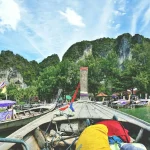
📷 Featured image by Phongpanot Phairatwetchaphan on Unsplash.