On this page
- The Island’s Quieter Geography — Where the Crowds Aren’t
- Beaches That Don’t Make the Highlight Reels
- Jungle Trails, Waterfalls, and the Interior
- The Food Scene Away from the Party Strip
- Yoga, Wellness, and Digital Nomad Life in 2026
- Getting to Koh Phangan Without the Chaos
- 2026 Budget Reality — What It Actually Costs
- Day Trip or Overnight? Stay Longer Than You Think
- Frequently Asked Questions
💰 Click here to see Thailand Budget Breakdown
💰 Prices updated: October, 2026. Budget figures are estimates — always verify before travel.
Exchange Rate: $1 USD = ฿33.60
Daily Budget (per person)
Shoestring: ฿900.00 – ฿1,800.00 ($26.79 – $53.57)
Mid-range: ฿2,150.00 – ฿4,000.00 ($63.99 – $119.05)
Comfortable: ฿6,000.00 – ฿12,000.00 ($178.57 – $357.14)
Accommodation (per night)
Hostel/guesthouse: ฿90.00 – ฿750.00 ($2.68 – $22.32)
Mid-range hotel: ฿1,400.00 – ฿3,500.00 ($41.67 – $104.17)
Food (per meal)
Budget meal: ฿70.00 ($2.08)
Mid-range meal: ฿250.00 ($7.44)
Upscale meal: ฿1,000.00 ($29.76)
Transport
Single metro/bus trip: ฿30.00 ($0.89)
Monthly transport pass: ฿1,155.00 ($34.38)
By 2026, Koh Phangan’s Full Moon Party has become a victim of its own legend. Monthly crowds regularly hit 30,000 people, the beach at Hat Rin is littered before midnight, and accommodation prices triple for the four days surrounding it. If you searched for this article, you already suspect there’s another version of this island — and there is. Koh Phangan is 168 square kilometres of mountainous jungle, empty bays, and fishing villages that most visitors never reach because they’re too busy counting down to the next fire show. This guide is for everyone who wants to find that other island.
The Island’s Quieter Geography — Where the Crowds Aren’t
Hat Rin, the party epicentre, sits on the southeastern tip. That single fact is your compass. Everything north, west, and northeast of Hat Rin operates at a completely different rhythm. The northern coast around Chalok Lam and Bottle Beach is separated from the south by a spine of forested hills that makes driving slow and deliberate — which naturally filters out anyone in a hurry. The west coast from Ao Cha Phaed down to Ao Sri Thanu has developed into a low-key strip of wellness retreats and family guesthouses. The northeast corner, accessible only by a rough road or longtail boat, barely registers on most tourist maps.
Understanding this geography changes how you plan. The island is not uniformly “party central” — it’s more like two or three different islands stitched together by a hilly interior. Choosing where you sleep determines almost everything about your experience.
Beaches That Don’t Make the Highlight Reels
Bottle Beach (Hat Khuat) on the north coast is the most obvious example of what Koh Phangan hides. There are no roads to it — you take a longtail from Chalok Lam village for around 100–150 THB each way, or hike a 45-minute jungle trail. The beach is a curved white strip backed by dense green hills, with maybe 20 sunbathers on a busy day. The water is clear enough to see your feet in two metres of depth.
Haad Salad on the northwest coast is almost as quiet, and more accessible by scooter. It faces west, so the late-afternoon light turns the whole bay orange and pink — the kind of scene that genuinely stops you mid-sentence. A handful of small resorts line the back of the beach, none of them chain properties.
Haad Yao, just south of Haad Salad, is slightly busier but still calm by any reasonable measure. It has better snorkelling than most beaches on the island, with a rocky headland at the southern end sheltering coral that survived the 2024 bleaching event reasonably well. Local dive shops here are smaller and more attentive than the volume operations down south.
Jungle Trails, Waterfalls, and the Interior
Most people rent a scooter on Koh Phangan and stick to the coast roads. The interior is almost entirely ignored, which is genuinely baffling because it’s the island’s most dramatic landscape. The highest point, Khao Ra, sits at 627 metres and can be reached via a trail starting near Ban Madua Wan village in the north-central part of the island. The hike takes around two hours return and is steep enough to earn the views — a full panorama of the Gulf of Thailand, with Koh Samui visible to the south on clear days.
Phaeng Waterfall, in the national park area, is the most visited interior spot and still manageable outside of weekends. The lower falls are a short walk from the parking area; the upper falls require another 30 minutes of uphill trail through forest where you’ll hear hornbills before you see them. The air up here smells of wet earth and crushed leaves — noticeably cooler than the coast.
Than Sadet National Park in the northeast protects a river that several Thai kings visited historically; their initials are carved into boulders along the stream. It sees far fewer visitors than Phaeng and has a raw, unmanicured feel that’s becoming rare on developed Thai islands.
The Food Scene Away from the Party Strip
Hat Rin’s food options are built for speed and maximum turnover — pizza, pad thai, buckets. Leave that area and the cooking improves dramatically. Chalok Lam village on the north coast has a small morning market where local fishermen’s families sell fresh catch and homemade curries from 06:30 to around 09:00. A bowl of kaeng som (sour curry with freshly caught fish) here costs 60–80 THB and tastes like it was made with a personal investment in the outcome.
The west coast around Sri Thanu and Haad Yao has accumulated a strip of small restaurants catering to the wellness crowd. These places are not uniformly vegetarian — many serve very good grilled seafood alongside their smoothie bowls. The night market at Thong Sala, the island’s main town, runs several evenings a week and is where locals eat. Grilled corn, moo ping (pork skewers), and fresh roti with condensed milk for dessert — the food is honest and cheap, with nothing performing for tourists.
Yoga, Wellness, and Digital Nomad Life in 2026
Koh Phangan’s wellness scene has matured considerably since its early reputation as a place people went to “find themselves” while still nursing a hangover. By 2026, the west coast is genuinely competitive with Koh Samui and Koh Lanta for yoga retreats and holistic health programmes. Agama Yoga near Mae Haad, despite various controversies in its past, has been replaced in prominence by smaller, independent studios running week-long and month-long programmes that are credible and professionally structured.
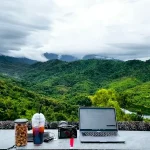
For digital nomads, the infrastructure improved substantially with fibre internet reaching most guesthouses on the west and north coasts by late 2025. Co-working space options remain limited compared to Chiang Mai or Bangkok, but several beachfront cafés on the west coast now have reliable 100+ Mbps connections and unwritten agreements with laptop workers. The Thai Long-Term Resident visa (LTR) introduced in earlier years continues to draw longer-stay visitors who use Koh Phangan as a base rather than a party destination.
Getting to Koh Phangan Without the Chaos
The standard route is a flight to Koh Samui (USM) from Bangkok’s Suvarnabhumi Airport, then a ferry — the crossing from Samui’s Nathon Pier to Thong Sala takes around 30 minutes by high-speed catamaran (around 300–400 THB). Bangkok Airways operates the Samui route frequently, but it’s expensive. The cheaper alternative is flying to Surat Thani (URT) on the mainland — multiple budget carriers serve this route for 800–1,800 THB — then taking a bus-ferry combination to Thong Sala. The total journey from Surat Thani airport takes three to four hours and costs roughly 350–500 THB all in.
Night trains from Bangkok’s Hua Lamphong or Bang Sue Grand Station to Surat Thani are a genuine pleasure — you board in the evening, sleep, and arrive on the coast in the morning. A second-class sleeper costs around 700–900 THB and the ferry connection from the train station to Koh Phangan is well-coordinated with arrival times.
If you’re travelling during or just after a Full Moon Party date, book everything at least three weeks in advance. The ferries and the roads leading to Hat Rin become genuinely difficult in the 24 hours surrounding the event.
2026 Budget Reality — What It Actually Costs
Budget travellers (fan rooms, local food, scooter rental): 800–1,200 THB per day. Fan bungalows on the north and west coast start at 400–600 THB per night. Scooter rental is 200–300 THB per day. Eating local runs 80–150 THB per meal.
Mid-range (air-con guesthouse or small resort, mix of local and tourist restaurants): 1,800–3,000 THB per day. Decent air-con rooms with hot water and a pool start at 1,000–1,800 THB per night on the quieter coasts.
Comfortable (boutique resort, villa rental, occasional spa treatment): 4,000–8,000 THB per day. The west coast has several well-designed boutique properties in the 3,000–5,500 THB per night range that offer real quality without the markup you’d pay on Koh Samui.
Note: During Full Moon Party weekend, all accommodation island-wide increases by 50–200%. If your dates overlap, either book months ahead or consider staying on Koh Samui and ferrying over for the night.
Day Trip or Overnight? Stay Longer Than You Think
Koh Phangan is technically reachable as a day trip from Koh Samui — the ferry is short, and you could spend a few hours at Thong Sala or a northern beach and return. But it’s a waste. The island rewards slow movement. The best beach (Bottle Beach) requires travel time each way. The interior trails need half a day minimum. The food scene reveals itself after you’ve walked the same village twice and the market vendor recognises you.
Three nights is the functional minimum to experience the non-party island meaningfully. Five to seven nights is where the place starts to feel like your own discovery rather than a stop on someone else’s itinerary. Longer-stay visitors consistently report that Koh Phangan “clicks” around day four — when the scooter rental guy waves as you pass, and you know which beach to go to at what hour of light.
Frequently Asked Questions
Is Koh Phangan worth visiting if I have no interest in the Full Moon Party?
Absolutely. The Full Moon Party is one event on one beach. The rest of the island — quiet bays, jungle trails, honest local food, a genuine wellness scene — operates independently of it. Many visitors who come specifically to avoid the party leave as the island’s strongest advocates. Just choose accommodation on the north or west coast.
When is the best time to visit Koh Phangan for calm weather?
December through April is the driest and calmest period for the Gulf of Thailand side, which is where Koh Phangan sits. September and October bring the most rain and occasional rough seas that can cancel boat services. The shoulder months of May and November offer reasonable weather with fewer tourists and lower accommodation prices.
Is it safe to ride a scooter on Koh Phangan?
The roads vary considerably. Coastal roads on the west and parts of the north are paved and manageable. Interior and northeast roads can be steep, unpaved, and genuinely dangerous for inexperienced riders, especially after rain. Wear a helmet — police checkpoints do issue fines, and hospitals on the island handle scooter injuries daily. Ride slowly and check your insurance coverage before renting.
Are there ATMs and reliable internet outside the main tourist areas?
ATMs are concentrated in Thong Sala town but exist in Chalok Lam and along the west coast strip. Withdraw enough cash when you’re in town, as remote beaches may have no ATM within 10 kilometres. Internet is now solid on the west and north coasts as of 2026, but the northeast and some interior bungalows still rely on mobile data, which is adequate with a Thai SIM.
Can I visit both Koh Phangan and Koh Samui in one trip?
Yes, and it’s a natural combination. Most travellers fly into Koh Samui, spend two or three nights there, then ferry to Koh Phangan for the quieter, more nature-focused experience. The reverse works equally well. Koh Tao, another 90 minutes north by ferry, can be added for diving, making a three-island trip that’s entirely practical within 10 days.