On this page
- What “Making Merit” Actually Means in Thai Buddhism
- The Five Most Common Offering Rituals Travelers Will Encounter
- Monk Alms Rounds (Tak Bat): How to Participate Respectfully
- Temple Offerings: Incense, Lotus Flowers, and Gold Leaf
- Spirit Houses and Everyday Offerings Outside Temples
- 2026 Budget Reality: What Offerings Cost
- What Not to Do: Mistakes That Cause Genuine Offence
- Frequently Asked Questions
Thailand sees record numbers of temple visitors in 2026, and with that comes a growing problem — well-meaning Travelers who participate in Buddhist rituals without understanding what they mean. Buying a lotus flower at the temple gate and copying what the person next to you does is fine as a start, but it leaves you disconnected from one of the most meaningful parts of Thai daily life. Merit-making (tham bun in Thai) is not a tourist activity. It is a living, daily practice woven into how Thai people understand kindness, karma, and their place in the cycle of existence. This guide explains it clearly, so you can engage with genuine respect rather than polite imitation.
What “Making Merit” Actually Means in Thai Buddhism
Thai Buddhism follows the Theravada tradition, the oldest surviving school of Buddhism, which places enormous importance on the concept of bun — merit. Merit is essentially positive spiritual energy accumulated through good actions. It improves your standing in this life, shapes the circumstances of your next rebirth, and ultimately moves you closer to liberation from suffering.
Thai people make merit constantly — not just at temples on Buddhist holy days, but in small, daily acts. Feeding monks at dawn, releasing a caged bird, donating to a school, helping a stranger — all of these are understood as merit-making. The motivation matters as much as the act itself. Merit made with genuine goodwill (cetana) carries more weight than merit made out of habit or social expectation.
The concept sits inside a broader Thai worldview where karma is not abstract but deeply practical. Most Thai people genuinely believe that the circumstances of their current life — health, wealth, relationships — reflect the merit and demerit accumulated in past lives. Making merit is an active, hopeful response to that reality. When a Thai grandmother wakes at 5am to place food in a monk’s bowl, she is doing something she believes has real spiritual consequences. Understanding that changes how you watch the scene unfold.
The Five Most Common Offering Rituals Travelers Will Encounter
Thailand has dozens of merit-making practices, but as a traveler you will repeatedly encounter five main types. Recognising them helps you understand what is happening around you — and whether you might participate.
- Dana (giving to monks): Offering food, robes, or everyday necessities to monks is the most fundamental merit-making act. Monks are considered a “field of merit” — giving to them generates more spiritual return than giving to ordinary people.
- Offering flowers, incense, and candles at shrines: This is the most accessible ritual for visitors. You present these three items while kneeling before a Buddha image and silently state your intention or gratitude.
- Gold leaf application: Pressing thin sheets of gold onto Buddha statues is a tactile, personal act of devotion. The gold physically adorns the Buddha, and the act is considered deeply meritorious.
- Releasing animals: Birds, fish, and turtles are sold near temples and waterways specifically for release. The practice is spiritually motivated but has attracted environmental criticism in 2026 — more on that in the mistakes section.
- Making donations (thod pha pa / thod kathin): Donating money or goods to support temple upkeep, monks’ education, or community projects. Donation boxes inside temples, and formal robe-giving ceremonies at the end of Buddhist Lent, fall under this category.

Monk Alms Rounds (Tak Bat): How to Participate Respectfully
The alms round — tak bat — is the daily procession in which monks walk silently through neighbourhoods at dawn, accepting food from laypeople. In tourist areas, especially Chiang Mai’s Old City and Luang Prabang across the border, tak bat has become heavily photographed. In Thailand’s smaller towns and residential neighbourhoods, it remains entirely genuine and deeply moving.
If you want to participate properly, here is what that looks like. You arrive before dawn — typically between 5:30am and 7:00am depending on the area — and purchase cooked rice or simple food items from vendors nearby. Remove your shoes. If you are a woman, you must not touch a monk or hand food directly to him — place the offering in his bowl or on a receiving cloth laid on the ground. Men may place food directly into the bowl. Keep your head lower than the monk’s as he receives the offering. Do not speak to him. Do not take photographs while he is directly in front of you.
The silence is not unfriendliness. Monks are in a state of focused mindfulness during tak bat. They chant blessings quietly and move without distraction. Watching respectfully from a short distance — without a camera in the monk’s face — is itself a form of respect that Thai people appreciate far more than they will ever say out loud.

Temple Offerings: Incense, Lotus Flowers, and Gold Leaf
Inside any Thai temple (wat), you will find vendors near the entrance selling small offering sets. A standard set typically includes three sticks of incense, two white candles, a lotus bud or garland of jasmine, and sometimes gold leaf sheets. The combined scent of jasmine and sandalwood incense drifting through a high-ceilinged temple hall, with light filtering through carved wooden screens, is one of those sensory experiences that stays with you long after you leave Thailand.
The ritual sequence follows a loose pattern. Light the incense and candles from a communal flame at the altar — never from a cigarette lighter if you can avoid it. Hold the incense between your palms in a prayer position (wai), close your eyes, and mentally state your intention: gratitude, a wish, a dedication of merit to a deceased relative. Then place the incense in the sand-filled urn, the candles in their holders, and lay the flowers at the base of the Buddha image.
Gold leaf is sold separately, usually in small packets of three to five sheets. You apply it by pressing it gently onto a specific part of a Buddha statue — different parts carry different associations. Pressing gold to the head is associated with wisdom and mental clarity. The chest relates to emotional wellbeing. The feet are associated with travel and journey. Thai people often choose deliberately based on what they are seeking.
Dress is non-negotiable. Cover your shoulders and knees before entering any temple building. Sarongs are often available to borrow at major temples for a small deposit, but bringing your own lightweight scarf is simpler. Remove your shoes before entering any building containing a Buddha image — the signage is clear, but the physical cue is the shoes lined up at the door.
Spirit Houses and Everyday Offerings Outside Temples
Merit-making in Thailand extends well beyond formal Buddhism. Almost every Thai home, business, hotel, and public building maintains a san phra phum — a spirit house — on its grounds. These miniature shrines house the protective spirit of the land and must be kept happy through regular offerings.
Spirit houses are not strictly Buddhist — they blend animist beliefs that predate Buddhism in Southeast Asia with Thai folk tradition. You will see them everywhere: a small ornate structure on a pedestal, garlanded with jasmine, holding tiny figurines of people and elephants, surrounded by incense sticks and small cups of red Fanta (a favourite of certain spirits, according to Thai belief).

As a visitor, you are not expected to make offerings at spirit houses. But you should not touch, lean against, point your feet toward, or photograph them disrespectfully. If a spirit house is positioned at the entrance to somewhere you are entering, step around it mindfully rather than brushing past.
You will also see offerings made at roadside shrines, ancient trees wrapped in sacred cloth, and images of revered monks displayed in shopfronts with incense burning below. All of these reflect the same underlying logic: the world is populated by forces that deserve acknowledgment, and a small act of generosity keeps those forces aligned with your wellbeing.
2026 Budget Reality: What Offerings Cost
Making merit is genuinely accessible at every budget level. The cost is minimal — the intention is what matters spiritually, and Thai Buddhism makes that explicit.
- Budget: A standard temple offering set (incense, candles, lotus bud) costs 20–40 THB from vendors outside major temples. Gold leaf packets are typically 10–20 THB for three sheets. A small bag of cooked rice for tak bat participation is around 20–30 THB.
- Mid-range: More elaborate offering sets with larger lotus garlands and multiple incense bundles run 60–100 THB. Pre-packaged monk donation bags containing items like soap, toothpaste, instant noodles, and a small envelope for cash cost 100–200 THB at markets near major temples.
- Comfortable: Participating in a formal merit-making ceremony such as sponsoring a monk’s robe donation (thod kathin) involves a cash contribution that typically starts at 500 THB but can go much higher. Temple restoration donations — depositing money into clearly labelled restoration fund boxes — have no fixed amount; 100–500 THB is common among Thai visitors.
In 2026, most major temples still do not charge entrance fees for Thai nationals, but popular tourist temples — including Wat Phra Kaew in Bangkok and Doi Suthep in Chiang Mai — charge foreign visitors entry fees of 200–300 THB. This is separate from any offerings you make inside.
What Not to Do: Mistakes That Cause Genuine Offence
The Thai concept of mai pen rai (never mind, it’s okay) means locals rarely correct tourists directly. That courtesy can mask the fact that certain behaviours are considered genuinely disrespectful rather than merely awkward.
- Do not photograph monks without permission, especially during tak bat. In 2026, drone photography near active temple ceremonies is banned under regulations that apply across all Thai heritage zones. Ground-level flash photography during alms rounds falls in the same category of disrespect.
- Do not buy birds or fish for release without research. The practice of releasing animals for merit (bun ploi nok ploi pla) has come under sustained criticism from Thai wildlife organisations. Many birds sold for release near temples are wild-caught and die shortly after release from stress. Some Thai Buddhist scholars now actively discourage it. If you want to participate in this tradition, donate instead to a wildlife rehabilitation fund.
- Do not enter a temple’s inner sanctuary (the ubosot) during an active ceremony unless invited. The ordination hall is sacred space used for formal monastic rituals. Wandering in with a camera during an active ceremony is a serious breach.
- Do not point your feet toward Buddha images or monks. The feet are the lowest, most spiritually impure part of the body in Thai belief. Pointing them at anything sacred — including spirit houses, monks, and Buddha images — is a direct insult, even if unintentional.
- Women: do not hand anything directly to a monk. This rule applies strictly. If you need to give something to a monk — including an offering — place it on a surface or cloth for him to receive. Physical contact between a monk and a woman breaks his monastic vows.
Frequently Asked Questions
Can non-Buddhists make offerings at Thai temples?
Yes, and Thai people generally welcome it. There is no requirement to be Buddhist to participate in offering rituals. The expectation is simply that you approach the experience with genuine respect and follow the physical etiquette — shoes off, dressed modestly, no disruptive photography. Many Thai Buddhists believe the intention behind an act matters more than the actor’s religion.
Is it rude to watch a monk alms round without participating?
Not at all. Observing quietly and respectfully from a distance is completely appropriate. The problem arises when observers crowd the monks, use flash photography, or speak loudly nearby. Standing calmly to the side, dressed modestly, and watching without a phone held up in the monk’s face is considered entirely respectful by Thai standards.
What should I say or think when making an offering at a temple?
There is no required script. Thai people typically focus mentally on a specific wish, express gratitude for blessings received, or dedicate the merit of the offering to a deceased family member. Silence and genuine intention are enough. You do not need to recite Pali prayers to make the act meaningful — Thai Buddhism emphasises the sincerity of the mind behind the gesture.
Are there offering etiquette differences between Bangkok temples and northern Thailand temples?
The core etiquette is consistent nationwide. In northern Thailand, particularly Chiang Mai, you may encounter Lanna-style temples with slightly different architectural features and regional Buddhist traditions, but the offering sequence — incense, candles, flowers, bowing — is the same. In Isaan (northeast Thailand), folk Buddhist practices blend more visibly with animist traditions, and spirit house offerings tend to be more elaborate.
Has anything changed about temple access or offering practices since 2024?
Yes. Several high-traffic temples introduced timed entry systems and designated offering zones in 2025–2026 to reduce crowding around sacred areas. Wat Phra Kaew in Bangkok now has clearly marked areas where tourists may observe versus areas restricted to active worshippers. Check individual temple websites before visiting, as protocols continue to evolve with rising visitor numbers.
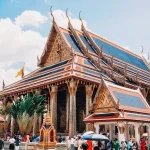
📷 Featured image by Surya Kleij on Unsplash.