On this page
- The Royal Family and Lese-Majeste Laws
- Temple Behaviour That Marks You as Disrespectful
- The Wai Greeting — When to Use It and When to Hold Back
- Head, Feet, and the Physical Hierarchy
- Bargaining Blunders — Where It Works and Where It Backfires
- Monk Etiquette — Rules That Apply to Everyone
- Volume, Emotion, and the Concept of Losing Face
- 2026 Budget Reality — Cultural Costs and Entry Fees
- Frequently Asked Questions
Thailand welcomed over 38 million international visitors in 2025, and with that volume comes a steady stream of well-meaning tourists who accidentally offend locals, get turned away from temples, or — in extreme cases — end up in serious legal trouble. The blunders are almost always avoidable. They come from gaps in cultural knowledge, not malicious intent. This guide covers the specific behaviours that cause the most friction, so you can focus on enjoying the country rather than digging yourself out of an embarrassing situation.
The Royal Family and Lese-Majeste Laws
Thailand’s lese-majeste laws are among the strictest in the world, and in 2026 they remain fully enforced. Under Section 112 of the Thai Criminal Code, any criticism, mockery, or perceived insult directed at the King, Queen, heir apparent, or regent carries a prison sentence of three to fifteen years — per count. Foreign nationals are not exempt. Several tourists have faced prosecution, and arrests continue to happen.
What this means practically:
- Do not make jokes about the royal family — not on social media, not in a bar, not in a private conversation with people you just met.
- Do not post images that could be interpreted as disrespectful, even if you consider them harmless satire.
- If a Thai banknote falls on the ground, do not step on it to stop it blowing away. The King’s image appears on all Thai currency, and stepping on it is considered deeply offensive — and has led to legal complaints in the past.
- When the royal anthem plays before films in cinemas, everyone stands. You stand too.
- At 8am and 6pm daily, the national anthem plays in public spaces. Many Thais stop and stand still. Following their lead is the respectful response.
The rule here is simple: if you are unsure whether something could be taken as disrespectful toward the monarchy, do not say it, post it, or do it.
Temple Behaviour That Marks You as Disrespectful
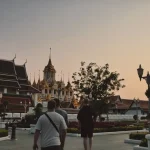
Temples — wats — are active places of worship, not tourist backdrops. The golden spires of Wat Phra Kaew catching the first light of dawn are genuinely awe-inspiring, but that same space is where monks pray, families make offerings, and communities gather for ceremonies. Your behaviour inside matters.
Dress code is the first and most visible issue. Both men and women must cover their shoulders and knees. Many popular temples — including Wat Pho and Wat Arun in Bangkok — provide sarong wraps at the entrance, sometimes free, sometimes for a small deposit. Wear them properly, not loosely draped so your knees are still visible.
Other specific behaviours to avoid:
- Pointing your feet at Buddha images or monks. Feet are the lowest, most spiritually impure part of the body. Sit with your legs folded to the side or in front of you — never pointing toward the altar.
- Touching Buddha images. Climbing on, hugging, or posing with a Buddha statue for a photo is deeply disrespectful. Images of tourists doing this circulate on Thai social media and generate real anger.
- Turning your back on the main Buddha image to take a selfie. Face the image when backing away.
- Entering without removing shoes. Signs are posted, but some people miss them. When in doubt, check whether there are shoes at the entrance.
- Raising your voice or laughing loudly. The atmosphere inside a temple is deliberately calm. Match it.
The Wai Greeting — When to Use It and When to Hold Back
The wai (ไหว้) is Thailand’s traditional greeting — palms pressed together at chest height, slight bow of the head. It communicates respect, gratitude, and acknowledgment. Getting it right earns genuine warmth. Getting it wrong is mostly just awkward, but it is still worth understanding the logic behind it.
The wai follows a hierarchy. The person of lower status initiates it. The person of higher status returns it at a lower position — or sometimes simply nods. The higher your hands and the deeper your bow, the greater the respect shown.
As a foreigner, you are not expected to perform it perfectly. But here is what to avoid:
- Do not wai service staff, children, or people clearly younger than you in a casual context. It creates awkwardness because they then feel obliged to return a greeting that protocol says they should have initiated.
- Do not wai monks in the standard way. The correct gesture toward a monk is a deeper bow with hands higher — near the forehead. If you are unsure, a respectful nod is safer than an incorrect wai.
- Do not wai with one hand — both palms together is the correct form. A single-hand wave is simply a Western gesture.
When someone gives you a wai, return it. Even a small, genuine attempt is appreciated.
Head, Feet, and the Physical Hierarchy
Thai culture assigns spiritual significance to different parts of the body. The head is the highest and most sacred part. The feet are the lowest and most impure. This creates a set of rules that governs everyday interaction in ways that may not be obvious to visitors.
- Never touch anyone’s head — not even a child’s in a playful ruffling gesture. It is considered a serious violation of personal and spiritual space.
- Do not point with your feet at people, objects, or religious items. If you are seated and someone walks by, pull your feet in.
- Do not pass objects over someone’s head — step around them or hand the item from a lower position.
- Avoid stepping over a person who is seated or lying on the ground. Walk around them.
- When handing money to someone, use both hands or your right hand supported by your left. Tossing change onto a counter is seen as dismissive.
Bargaining Blunders — Where It Works and Where It Backfires
Bargaining is part of the culture in markets, with tuk-tuks, and at street vendors selling clothing, souvenirs, and similar goods. But there is a right way to approach it, and a way that causes genuine offence.
What not to do:
- Do not bargain in 7-Eleven, restaurants, or any fixed-price shop. Prices are set. Asking for a discount in these contexts is embarrassing for everyone involved.
- Do not open aggressively low. Cutting a 200 THB asking price to 20 THB with a dismissive tone is insulting. A counter-offer of 50–70% of the asking price is a reasonable opening in a market context.
- Do not walk away from a deal you actually agreed to. If a vendor accepts your offer, you are expected to follow through. Backing out after they have said yes is considered dishonest and causes a loss of face.
- Do not bargain over food. A bowl of noodles costs what it costs. Haggling over a 50 THB meal is considered demeaning to the person cooking it.
Keep the tone light and friendly throughout. Bargaining in Thailand is meant to feel like a conversation, not a confrontation.
Monk Etiquette — Rules That Apply to Everyone
Buddhist monks hold a position of enormous respect in Thai society. There are specific rules around interacting with them, and breaking them — even innocently — creates real discomfort.
For women specifically: you must never touch a monk, hand anything directly to a monk, or sit next to one on public transport. If a woman needs to give something to a monk, she places it on a cloth he provides, or hands it to a man who then passes it on. This is not a rule about gender inequality — it is a monastic code that monks have taken vows to uphold, and breaking it requires them to undergo ritual purification.
For everyone:
- Do not interrupt a monk who is meditating or walking on his morning alms round.
- Do not photograph monks without asking first — and respect a refusal.
- On public transport, give up your seat for a monk without being asked.
- Do not engage in loud or flippant conversation with a monk. If they wish to talk, follow their lead.
Volume, Emotion, and the Concept of Losing Face
Thai social culture places enormous value on saving face — maintaining dignity and composure in public interactions. Raising your voice, expressing frustration loudly, or publicly shaming someone causes a loss of face for both parties and is considered a serious social failure.
This comes up most often when things go wrong — a wrong order, a driver taking a longer route, a hotel room that does not match what was booked. The natural Western response of expressing displeasure directly and firmly is read in Thailand as aggression, not assertiveness. It does not get problems solved faster. It usually makes staff shut down and look for a way to end the interaction rather than fix the issue.
What works instead: stay calm, smile, and explain the problem quietly. The Thai phrase mai pen rai (ไม่เป็นไร — “never mind / it’s okay”) embodies an approach to friction that keeps relationships intact. Adopting that spirit — even when you are genuinely frustrated — will get you much further than losing your temper.
The same applies to public displays of affection. While attitudes have relaxed in 2026, especially in Bangkok, extended kissing or physical intimacy in public — particularly near temples or in smaller towns — still draws uncomfortable looks and quiet disapproval.
2026 Budget Reality — Cultural Costs and Entry Fees
Most cultural experiences in Thailand are affordable, but there are real costs attached to some sites and dress code requirements.
- Budget: Entry to smaller local temples is usually free. Basic sarong wraps loaned at major temples cost 0–50 THB deposit, returned when you leave.
- Mid-range: Major Bangkok temples — Wat Phra Kaew (Grand Palace complex) costs 500 THB per person in 2026. Wat Pho is 200 THB. These prices increased modestly from 2024 levels.
- Comfortable: Guided cultural tours that include temple visits, etiquette briefings, and traditional merit-making experiences range from 1,500–3,500 THB per person depending on duration and group size.
- Dress code rental: If you arrive at a major temple without appropriate clothing, on-site cover-up rentals typically cost 50–100 THB. Buying a cheap linen top or lightweight trousers from a street market before your visit — typically 100–200 THB — is more practical and reusable.
One 2026 update: several major temples have introduced cashless payment systems at entry points. Carrying a Thai QR-compatible payment method (Prompt Pay, or a card that supports contactless) speeds things up considerably during peak visitor hours.
Frequently Asked Questions
Is it really illegal to criticise the Thai royal family as a tourist?
Yes. Thailand’s lese-majeste law applies to everyone on Thai soil, regardless of nationality. Prosecutions of foreign nationals have occurred. The safest approach is to avoid the topic entirely in public, on social media, and in conversations with people you do not know well. The legal consequences are severe and the courts do not treat foreigners as a special case.
What should I wear to a temple in Thailand?
Shoulders and knees must be covered for both men and women. Loose trousers or a long skirt and a t-shirt or blouse with sleeves are ideal. Many temples provide sarong wraps at the entrance. Shoes must be removed before entering the main hall. Avoid sleeveless tops, shorts, and tight or sheer clothing regardless of the heat.
Is it okay to take photos of monks?
You should always ask permission before photographing a monk. Many will agree, but some — particularly during meditation or alms rounds — prefer not to be photographed. Respect a refusal without argument. Never photograph monks performing private rituals or inside monastery quarters without explicit permission.
Can I bargain everywhere in Thailand?
Bargaining is normal at outdoor markets, with tuk-tuks and some taxi drivers (before getting in), and at souvenir stalls. It is not appropriate in restaurants, convenience stores, malls, or any shop with marked prices. Never bargain over street food. Keep the tone friendly — aggressive haggling damages the interaction even when it technically works.
What does losing face mean in Thai culture and why does it matter for tourists?
Losing face means being publicly embarrassed or having your dignity undermined. In Thai culture, this is taken seriously by all parties involved. Shouting at someone, pointing out their mistake loudly, or humiliating them in front of others causes deep discomfort — and rarely resolves the problem. Staying calm and polite consistently produces better outcomes in Thailand than expressing frustration does.
📷 Featured image by Jochen van Wylick on Unsplash.