On this page
- Why Thai Greetings Carry More Weight Than You Think
- The Wai: Thailand’s Physical Greeting Explained
- Sawadee: Breaking Down the Most Important Word in Thai
- Greetings for Specific Situations
- Reading the Room: When Thais Won’t Expect a Wai Back
- Common Greeting Mistakes Foreigners Make
- 2026 Budget Reality: Language Tools and Resources
- Beyond Hello — Follow-Up Phrases That Complete a Respectful Greeting
- Frequently Asked Questions
Plenty of travellers arrive in Thailand in 2026 having memorised “sawadee krap” from a YouTube video, then freeze the moment an actual Thai person responds. The issue isn’t vocabulary — it’s context. Thai greetings aren’t just words you swap out like currency. They carry social rank, tone, and physical gesture all at once. Get the combination wrong and you can come across as dismissive or even mildly offensive without meaning to. Get it right, and Thais will light up in a way that no guidebook photo can quite capture.
Why Thai Greetings Carry More Weight Than You Think
Thailand runs on a concept called kreng jai — a kind of social consideration that prioritises harmony and avoiding embarrassment for others. Greetings are the opening move in this social game. They signal whether you understand the room or not. A careless greeting doesn’t just feel awkward; it can cause mild loss of face (sia na) for the person you’re greeting, because they don’t know how to calibrate their response to you.
This matters more in 2026 than it did a decade ago. Thailand received record international arrivals after the tourism recovery of 2023–2024, and Thais in tourist-heavy areas have grown more accustomed to foreign behaviour. But that familiarity cuts both ways. Thais notice when a foreigner makes a genuine effort, and they notice equally when someone is just going through the motions. The mai pen rai spirit — the famous Thai “never mind, it’s fine” attitude — doesn’t mean Thais are indifferent to how you greet them. It means they won’t make you feel bad about it. The appreciation for effort is still very much there.
Thai culture is also deeply hierarchical, shaped by centuries of Buddhist values and royal tradition. Age, social status, and profession all affect how greetings are exchanged. This isn’t rigid or stressful — Thais are genuinely warm and forgiving with foreigners — but understanding the logic behind the hierarchy is what separates a polite tourist from a respectful guest.

The Wai: Thailand’s Physical Greeting Explained
The wai (ไหว้) is Thailand’s defining gesture. You press your palms together in front of your chest — fingers pointing upward — and bow your head slightly. Think of it as a prayer position that you’re directing at another person rather than a deity. The physical execution matters, and so do the variations.
Hand position and height
The height of your hands signals the level of respect. Here’s how it breaks down:
- Fingertips at nose level: Used when greeting monks or the very elderly. This is the highest form of the wai.
- Fingertips at chin or mouth level: For elders, teachers, bosses, and people significantly older or senior to you.
- Fingertips at chest level: For peers — people roughly your own age and social standing.
The bow that accompanies the wai is equally important. A deep bow (head nearly to your hands) signals the deepest respect. A slight tilt of the head is enough for social equals. Many foreigners forget the bow entirely and just hold their palms together like they’re about to sneeze — this looks incomplete and a little confused.
Who initiates the wai
In Thai social logic, the person of lower status initiates the wai, and the person of higher status returns it. A younger person wais an older person first. A customer can expect a wai from shop staff, but doesn’t necessarily need to initiate one. A student wais a teacher first.
As a foreign visitor, you are in a socially ambiguous position. You’re a guest, which carries respect in Thai culture, but you’re also a stranger whose status is unknown. The safest approach: let Thais initiate the wai in formal or unclear situations, and always return a wai gracefully when one is offered to you. Failing to return a wai — just standing there nodding — is one of the more common and unnecessary offences foreigners commit.

Sawadee: Breaking Down the Most Important Word in Thai
The word sawadee (สวัสดี) is the foundation. It works as hello, good morning, good afternoon, good evening, and goodbye — context does the heavy lifting. But the word alone isn’t complete. What follows it is what marks you as someone who actually understands Thai communication.
The gendered particles: krap and ka
Thai adds a polite particle to the end of greetings (and most polite sentences) based on the speaker’s gender:
- Krap (ครับ) — used by male speakers. Sometimes written “krub” or “khrap” in romanised Thai.
- Ka (ค่ะ / ครับ) — used by female speakers. When asking a question, it becomes “ka” with a rising tone; when making a statement, it’s “ka” with a falling tone.
So the full greeting is:
- Sawadee krap — said by men
- Sawadee ka — said by women
These particles aren’t optional decorations. Dropping them in a greeting makes you sound abrupt, like you’re issuing a command rather than offering a greeting. Thai children are taught from a very young age to always include them. As a foreigner, using them correctly is one of the fastest ways to earn a genuine smile.
Pronunciation and tone
Thai is a tonal language with five tones: mid, low, falling, high, and rising. Mispronouncing a tone can change a word’s meaning entirely — sometimes comically, sometimes embarrassingly. For sawadee, the breakdown is:
- Sa — mid tone, short
- wa — mid tone
- dee — mid tone, this syllable carries the warmth of the word
The word is often stretched slightly in practice: “sa-wa-DEE” with gentle emphasis on the final syllable. Thais rarely correct foreigners’ tones on greetings because the word is well-known and context is clear. But making the effort to say it cleanly — rather than rushing through it with a Western cadence — is immediately noticeable.

Formal versus casual
Among close friends, young Thais often drop sawadee altogether and use hey or a nickname shout. But as a foreigner, always default to sawadee krap/ka. It signals respect without being stiff or overly ceremonial. Save the casual shorthand for situations where a Thai friend explicitly teaches you their personal greeting style.
Greetings for Specific Situations
The same sawadee krap/ka works in most social situations — but knowing how to adjust for specific contexts shows a depth of cultural understanding that Thais genuinely appreciate.
Greeting monks
Buddhist monks occupy the highest tier of respect in Thai society. When you encounter a monk — at a temple, on the street, or on public transport — the appropriate wai is hands at nose level with a low, deliberate bow. Do not touch monks. Women especially must not make physical contact with monks or hand them anything directly. If you need to give something to a monk, place it within reach or hand it to a male intermediary.
The verbal greeting for monks is sawadee krap/ka, but many laypeople also say “Namo Buddhaya” (a Pali Buddhist phrase of reverence) in very formal temple contexts. For most casual encounters, sawadee with the correct wai is perfectly appropriate and deeply respectful.

Greeting elders and family members
If you’re introduced to a Thai family — perhaps at a homestay or through a local friend — greet the oldest person in the room first. This is non-negotiable in traditional Thai households. The chin-to-mouth level wai is right for people noticeably older than you. Address older Thais as Khun (คุณ) followed by their first name — Khun Somchai, for example. Khun is a gender-neutral honorific that works for Mr., Mrs., and Ms.
Greeting shopkeepers and service staff
A warm sawadee krap/ka when entering a small shop, restaurant, or guesthouse costs you nothing and sets a genuinely positive tone for the interaction. You don’t need to wai shopkeepers — a smile and the verbal greeting is enough. They will often wai you as part of their service greeting; return it at a similar hand height to what they offer.
Greeting officials
At immigration counters, government offices, or police checkpoints, keep your greeting formal: clear sawadee krap/ka, a respectful wai at chin level, and a composed demeanour. Avoid overly casual body language. Thais read posture as part of the greeting package.
Reading the Room: When Thais Won’t Expect a Wai Back
One of the most useful things to understand about the wai is when not to return one. This sounds counterintuitive, but it follows the same logic as the hierarchy: the higher-status person doesn’t always need to fully reciprocate.
When a child wais you — perhaps the young child of a guesthouse owner or a student on a school trip — a full formal wai in return would reverse the social order and cause mild confusion. Instead, acknowledge with a warm smile and a slight nod. This communicates that you received the greeting with warmth, without upending the social dynamic.
Similarly, when service workers in high-turnover tourist settings give a quick, formulaic wai — think convenience store staff or hotel doormen — they’re performing a professional courtesy rather than a personal social greeting. A smile and a nod is the natural response. You don’t need to stop, press your palms together, and bow every time someone at 7-Eleven greets you. This actually makes transactions feel awkward rather than warm.
The principle is simple: match the energy and depth of the greeting offered. A deep, deliberate wai deserves a deep, deliberate response. A quick service wai deserves a warm but brief acknowledgment.
Common Greeting Mistakes Foreigners Make
Most greeting errors come from good intentions paired with incomplete information. These are the patterns that show up most often in 2026, particularly among first-time visitors and short-term tourists.
- The handshake override: Extending a hand for a Western handshake when someone is beginning to wai. This leaves the Thai person mid-gesture with nowhere to go. Wait to see how a Thai person initiates before offering your hand.
- The selfie wai: Using the wai pose purely for social media photos, especially in or near temples, without any greeting context. This is widely recognised as performative and mildly disrespectful. The wai is a gesture with meaning — not a photo prop.
- Wai-ing Buddha images and temple statues casually: A quick, tourist-style wai in front of a sacred image while chatting or holding your phone looks flippant. If you’re going to wai a Buddha image, do it deliberately and with both hands properly positioned.
- Saying sawadee without the particle: “Sawadee!” alone sounds like you learned it from a billboard. Adding krap or ka takes one extra syllable and makes the greeting complete.
- Wai-ing children below roughly 10–12 years old: This reverses the social hierarchy in a way that confuses rather than honours.
- Wai-ing someone who is carrying bags or food with both hands: They physically cannot return it and feel awkward. A nod of acknowledgement is better here.
- Wai-ing a monk with only a chest-level wai: Monks occupy the highest respected class in Thai society and deserve the nose-level gesture.
2026 Budget Reality: Language Tools and Resources
Learning Thai greetings is free — but in 2026 there are several tools and resources worth knowing about, along with their real costs.
Apps and digital tools
- Google Translate (free): The camera translation feature has improved significantly by 2026 and handles Thai script with reasonable accuracy in standard fonts. Useful for menus and signs, not subtle social situations.
- Ling Thai (subscription): Approximately THB 250–400 per month or THB 1,500–2,000 for a yearly plan. One of the better structured apps for spoken Thai with tonal pronunciation guides.
- Pimsleur Thai (subscription): Around THB 1,800–2,500 per month. Audio-heavy, good for tonal practice during travel.
SIM cards and connectivity
Staying connected in Thailand in 2026 is straightforward. Tourist SIM cards from AIS, DTAC (now merged with True into NTRUE following the 2023 merger’s full integration), and True Move H are available at Suvarnabhumi, Don Mueang, and most 7-Eleven stores.
- Budget option: 30-day unlimited data SIM — approximately THB 299–399
- Mid-range option: 30-day SIM with higher-speed data cap and calls — approximately THB 499–699
- eSIM (for compatible phones): Available via apps like Airalo or directly through Thai carriers; approximately THB 350–600 for 15–30 days
Phrasebooks and printed materials
- Pocket Thai phrasebooks are available at major bookstores (Asia Books, B2S) for THB 150–350. The Lonely Planet Thai Phrasebook remains one of the most practical for travellers.
- Free laminated greeting cards are sometimes offered at tourism authority (TAT) offices — worth picking up if you’re in a TAT-staffed area.
Beyond Hello — Follow-Up Phrases That Complete a Respectful Greeting
A greeting that stops at sawadee krap/ka is polite. A greeting that flows naturally into a follow-up phrase signals genuine effort and usually delights Thais enormously.
Pai nai? — Where are you going?
Pai nai? (ไปไหน) — literally “going where?” — is one of the most common casual greetings among Thais who know each other. It’s the Thai equivalent of “how’s it going?” and doesn’t actually demand a specific destination as an answer. The standard friendly reply is pai thiao (ไปเที่ยว) — “just going out” or “going for a stroll.” If a Thai neighbour or guesthouse host greets you with this phrase, responding with pai thiao, krap/ka and a smile is entirely natural.
Sabai dee mai? — How are you?
Sabai dee mai? (สบายดีไหม) — “Are you well?” The standard happy response is sabai dee, krap/ka — “I’m well, thank you.” You can add khop khun krap/ka (ขอบคุณครับ/ค่ะ) for “thank you.” This exchange, spoken with the easy cadence of someone who’s practiced it, sounds genuinely friendly rather than textbook-rehearsed.
Chue arai? — What’s your name?
Chue arai krap/ka? (ชื่ออะไรครับ/ค่ะ) — “What is your name?” To answer: Pom chue [name] krap for men (“I am called [name]”) or Chan chue [name] ka for women. Many Thais will offer their nickname — Thai nicknames (chue len) are short and often playful (Noi, Lek, Moo, Golf, Bank). Using someone’s nickname after being told it is warmly received.
Yin dee tee dai ruujak — Pleased to meet you
Yin dee tee dai ruujak (ยินดีที่ได้รู้จัก) — “Pleased to meet you.” This is slightly more formal and works well in introductory settings — meeting your Thai host family, a guesthouse owner, or a colleague. It’s longer and harder to pronounce correctly, but Thais will appreciate the effort even if your tones aren’t perfect.
The point of these follow-up phrases isn’t to have a full conversation in Thai — most interactions in tourist areas will shift back to English quickly. The point is to show that you came to Thailand with some awareness of who you’re talking to. That awareness, expressed through even a handful of phrases used at the right moment, changes the quality of your interactions in ways that are hard to quantify but immediately felt.
Frequently Asked Questions
Do I have to wai everyone I meet in Thailand?
No. The wai is context-dependent. You should return a wai when one is offered to you, and initiate one when meeting someone clearly older or senior. In casual street encounters, tourist settings, and with children, a smile and nod is perfectly acceptable.
Is it rude to say sawadee without krap or ka?
It’s not deeply offensive, but it sounds incomplete — like greeting someone with just a noise rather than an actual word. The polite particles krap (men) and ka (women) are what make sawadee a complete greeting. Dropping them marks you as someone who half-learned the phrase. Adding them takes one syllable and makes an immediate positive difference.
Should female travellers wai monks?
Yes, women can and should offer the respectful wai to monks — hands at nose level, with a low bow. What women must not do is physically touch monks or hand objects directly to them. Place offerings on a cloth or surface, or pass them through a male intermediary. This is a firm Buddhist observance, not a cultural preference.
Do Thais actually appreciate foreigners trying to speak Thai, or does it feel forced?
Genuinely appreciate it — without exception in our experience. Thailand’s tourism industry is sophisticated in 2026, and Thais have seen every variety of tourist behaviour. A foreigner who makes a real effort with greetings and basic phrases is still warmly received. The key is sincerity over perfection. A mispronounced but genuinely offered sawadee krap beats a perfectly pronounced phrase delivered flatly.
What should I do if a Thai person’s wai is so fast I don’t have time to return it?
Catch it on the back end with a brief palms-together gesture and a nod. Thais understand that foreigners aren’t always primed for the exchange speed. What matters is acknowledging the gesture at all. A warm smile immediately after a missed wai also communicates that you noticed and appreciated it — this recovers the moment gracefully.
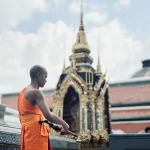
📷 Featured image by Worachat Sodsri on Unsplash.