On this page
- Why Thai Phrases Still Matter in a Translation-App World
- Understanding Thai Tones Before You Speak
- Greetings and Basic Politeness: The Foundation of Every Exchange
- Asking Questions and Getting Directions
- Eating, Drinking, and Ordering Food
- Shopping and Bargaining Phrases
- Emergency and Safety Phrases
- Reading the Room: When Language Is About Silence, Not Words
- 2026 Budget Reality: Language Learning Resources
- Frequently Asked Questions
Why Thai Phrases Still Matter in a Translation-App World
In 2026, every traveller arrives in Thailand with Google Translate downloaded, a eSIM already active, and quiet confidence that language won’t be a barrier. And for reading menus or deciphering signs, that confidence is mostly justified. But here’s where visitors consistently get tripped up: Thai people respond to effort. When a foreigner attempts even three words of Thai — however imperfectly pronounced — the entire temperature of an interaction changes. Smiles widen. Prices stop inflating. Tuk-tuk drivers stop treating you like a walking wallet. No translation app replicates that social currency. The 20 Phrases in this article aren’t about fluency. They’re about the small moments that separate a transactional trip from a genuinely warm one.
Understanding Thai Tones Before You Speak
Thai is a tonal language, which means the pitch you use when saying a syllable changes its meaning entirely. There are five tones: mid, low, falling, high, and rising. The classic example used in every Thai classroom is the word mai, which can mean new, wood, burn, not, or a question marker — depending entirely on tone. For most visitors, memorising all five tones before arrival is unrealistic. But understanding that they exist will stop you from getting frustrated when a Thai person looks confused after you attempt a phrase.
A practical shortcut: focus on the two extremes. A rising tone lifts at the end, like an English question. A falling tone drops firmly, like a statement. Many common tourist phrases use mid or low tones — relatively flat delivery — which gives beginners a fighting chance. When in doubt, speak more slowly and more clearly rather than louder. Volume does not resolve a tone problem.
The romanised spellings used throughout this article are simplified phonetic guides, not official transcription systems. Thai script is its own alphabet with 44 consonants and 32 vowels, and most tourists will never need to read it. Focus on the sounds.
Greetings and Basic Politeness: The Foundation of Every Exchange
Thai social interaction begins with acknowledgement. Skipping a greeting and going straight to a request — even at a 7-Eleven counter — is considered mildly rude. These phrases create the foundation for every interaction you’ll have.
1. Sawadee krap / Sawadee ka — Hello / Goodbye
Pronounced: sa-WAD-dee KRAP (men) / sa-WAD-dee KAA (women)
The universal Thai greeting and farewell. Krap is the polite particle used by men; ka is used by women. Using the wrong one won’t offend anyone — Thai people are used to confused foreigners — but using the correct one signals real awareness. This phrase works for hello, goodbye, good morning, and good evening. One phrase, four situations covered.
2. Khop khun krap / Khop khun ka — Thank you
Pronounced: KOHP-khun KRAP / KOHP-khun KAA
Use this constantly. After every transaction, every meal, every time someone holds a door. Thai hospitality culture places high value on acknowledgement, and a genuine thank you — not muttered at the floor but said with eye contact — lands every time.
3. Mai pen rai — No worries / It’s fine / Never mind
Pronounced: mai pen RAI
This phrase carries philosophical weight in Thailand. It’s the verbal expression of the Thai tendency to defuse tension and move forward without drama. If you bump into someone, spill something, or make a small mistake, mai pen rai — from you or from them — closes the loop gracefully. Visitors who use it appropriately get immediate recognition as culturally aware travellers.

4. Chai / Mai chai — Yes / No
Pronounced: CHAI / mai CHAI
Simple and essential. Note that Thai people often avoid a direct “no” in social situations to preserve face for both parties. If someone seems to be saying yes while meaning no, read the hesitation, the softened smile, the pause. Mai chai said firmly is unambiguous, but most Thais will soften a refusal with something like mai dai (cannot) rather than a blunt no.
5. Kho thot — Excuse me / Sorry
Pronounced: KOR-TOHT
Use this when squeezing past someone, interrupting a conversation, or making a minor error. In crowded night markets — where the smell of grilling satay and the press of bodies makes navigation a full-body exercise — kho thot gets you through gaps more effectively than shouldering forward silently.
Asking Questions and Getting Directions
These phrases help you gather information without pulling out your phone and pointing at a map, which — in smaller towns and with older locals — often produces shrugs rather than answers.
6. Tee nee tao rai? — How much is this?
Pronounced: tee NEE tao RAI
The most-used practical phrase in any traveller’s toolkit. Point at the item, say tao rai, and you’ll usually get a number held up on a calculator or written on a piece of paper. Useful everywhere from floating markets to tailor shops in Bangkok’s Sukhumvit district.
7. Yoo tee nai? — Where is it?
Pronounced: yoo tee NAI
Place the location before the phrase: [place] yoo tee nai? For example, hong nam yoo tee nai? means “Where is the toilet?” — possibly the most practically valuable sentence in this entire list. Hong nam (toilet) is worth committing to memory as a standalone word.
8. Pai [destination] dai mai? — Can I go to [place]?
Pronounced: pai [place] dai MAI
![8. Pai [destination] dai mai? — Can I go to [place]?](https://images.unsplash.com/photo-1698423846501-cc5c25d07e85?ixid=M3w5Mjc3MDl8MHwxfHNlYXJjaHw4fHxsYW5ndWFnZV90aXBzfGVufDB8MXx8fDE3ODAxMTQ4MTF8MA&ixlib=rb-4.1.0&w=350&fit=crop&auto=format&q=80&h=525)
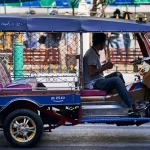
Used with taxi drivers and songthaew (shared pickup truck taxi) drivers. Pai means “go to.” Dai mai means “is it possible?” Together: Pai Chatuchak dai mai? — “Can you take me to Chatuchak?” This phrase gets a clearer response than simply naming a destination, because it frames the conversation as a negotiation rather than an assumption.
9. Nit noi — A little
Pronounced: NIT-noy
This word does a lot of work. Phet nit noi means “a little spicy.” Phuut Thai nit noi means “I speak Thai a little.” When a vendor or host realises you’re attempting Thai and asks if you speak the language, this humble response produces genuine warmth rather than the expectation that the rest of the conversation will happen in Thai.
10. Khao jai mai? / Khao jai — Do you understand? / I understand
Pronounced: KAO jai MAI / KAO jai
When communication hits a wall, khao jai mai? checks comprehension on both sides. If you’ve understood something, khao jai confirms it without nodding ambiguously. Useful in any negotiation or instruction-giving situation, including at pharmacies and guesthouses.
Eating, Drinking, and Ordering Food
Thai food culture is central to daily life in a way that isn’t comparable to most other countries. Meals are communal, frequent, and emotionally significant. Getting a few food-related phrases right earns you access to experiences that simply aren’t available to travellers who only point and nod.
11. Aroy — Delicious
Pronounced: a-ROY
Say this after your first bite of anything — the som tum at a roadside stall in Chiang Mai, the boat noodles in a Bangkok shophouse with the rich, dark broth that’s been simmering since morning — and watch the cook’s face shift from professional neutral to genuinely pleased. Aroy maak means “very delicious” and is appropriate for when a meal genuinely stops you mid-conversation. These two words cost nothing and return more goodwill than any tip.

12. Mai phet — Not spicy
Pronounced: mai PET
Thai “not spicy” and international “not spicy” are not the same measurement. If you have a low tolerance, follow this phrase with nit noi phet (a little spicy) or gesture with your fingers to reinforce the point. Thai chefs genuinely try to accommodate — this isn’t a phrase that offends.
13. Phet maak — Very spicy
Pronounced: PET MAAK
For those who want to signal their heat tolerance and get the authentic preparation rather than the tourist version. Saying phet maak at a som tum cart tends to produce a moment of assessment from the vendor — they’ll look at you, pause, and then either respect the request or gently test you with medium heat first.
14. Check bin — The bill, please
Pronounced: CHECK bin
Derived from English, so the pronunciation is intuitive. In most Thai restaurants — particularly local spots without English-language service — staff will not bring your bill until you ask. Flagging someone down and saying check bin krap/ka is the standard signal. Some newer Bangkok restaurants in 2026 use QR code payment systems, but the phrase remains universally understood everywhere outside the city’s premium dining scene.
15. Nam plao — Drinking water
Pronounced: nam PLAO
Nam means water. Nam plao specifically means plain drinking water, distinguishing it from sparkling water (nam soda) or ice water. Useful when ordering at restaurants where bottled water is standard. In 2026, tap water in Thailand is still not reliably safe to drink in most regions — always confirm you’re receiving sealed bottled water, particularly outside Bangkok.
Shopping and Bargaining Phrases
Bargaining in Thailand is a genuine cultural practice at markets and with independent vendors — not a confrontational activity, but a social one. The exchange should feel light and good-humoured. These phrases help you participate rather than simply endure it.

16. Lot noi dai mai? — Can you lower the price a little?
Pronounced: LOT noy dai MAI
The standard opening to any price negotiation. Polite, non-aggressive, and signals that you understand how the process works. Pair it with a genuine smile. Counter-offers delivered with hostility or impatience will simply make the vendor raise the price back up. The game is social, not adversarial.
17. Phaeng pai — Too expensive
Pronounced: PAENG pai
Said with a slight laugh rather than a grimace, this phrase is a negotiating signal, not an accusation. Vendors hear it constantly and respond to the tone, not just the words. The key is to deliver it and then pause — letting the seller make the next move rather than immediately countering with a number yourself.
Emergency and Safety Phrases
Most travellers never need these. But having them ready means that if you do need them, panic doesn’t cost you critical seconds.
18. Chuay duay! — Help!
Pronounced: CHOO-ay DOO-ay
The phrase to shout in an emergency. Loud, clear, and unmistakable to any Thai person nearby. In medical or safety emergencies in 2026, the national emergency number remains 1669 for ambulance and 191 for police — but having chuay duay ready can mobilise help from people physically near you before any call connects.
19. Rong phayaban yoo tee nai? — Where is the hospital?
Pronounced: RONG pa-ya-BAHN yoo tee NAI
Rong phayaban means hospital. This phrase combines the direction-finding structure from earlier in the article. In smaller towns outside major tourist zones, knowing this phrase verbally — rather than trying to type it into a phone with shaking hands — can matter significantly.
20. Pom/Chan mai sabai — I am not feeling well
Pronounced: POHM mai sa-BAI (men) / CHAN mai sa-BAI (women)
Sabai means comfortable, well, at ease. Mai sabai means the opposite. This phrase communicates illness or discomfort clearly enough that a Thai person will understand immediately and usually respond with genuine concern and practical assistance.

Reading the Room: When Language Is About Silence, Not Words
Thai communication has an entire layer that exists beneath vocabulary. Understanding it makes your phrases land better and stops you from accidentally causing offence with technically correct words delivered in the wrong social context.
The wai — palms pressed together, a slight bow of the head — is the physical language that accompanies verbal greetings. As a foreigner, you are not expected to initiate the wai, but returning one when it’s offered to you is respectful. The height of the wai communicates social hierarchy: higher hands indicate greater respect. Wai-ing a street food vendor or taxi driver as an equal is fine and appreciated. Wai-ing monks, elders, and anyone in a senior professional position signals genuine cultural awareness.
Raising your voice in frustration — even during a tense negotiation or a legitimate complaint — immediately collapses the interaction. Thai culture navigates conflict through indirectness and face-saving, not confrontation. A calm, flat delivery of your concern, followed by silence, will get you further than escalating volume. This applies especially in situations involving the police, hotel management disputes, or transport disagreements.
Finally: the Thai smile carries multiple meanings. A smile can signal happiness, agreement, embarrassment, discomfort, or a polite way of saying no. Learning to read the context around a smile — the eyes, the pause, the body position — is more valuable than any single phrase.
2026 Budget Reality: Language Learning Resources
You don’t need to spend anything to learn the basics before your trip, but some paid tools are genuinely worth the cost for longer stays or repeat visitors.
- Budget (Free): Google Translate’s Thai offline pack (download before arrival), the Ling app’s free tier covering basic phrases, YouTube channels dedicated to Thai for travellers. Cost: 0 THB.
- Mid-range (Low cost): Pimsleur Thai subscription for one month — approximately 600–800 THB. Covers audio-based tonal learning that written guides cannot replicate. The best single investment for anyone staying longer than two weeks.
- Comfortable (In-country options): Short Thai language classes at private schools in Chiang Mai and Bangkok run approximately 300–600 THB per hour for one-on-one tuition in 2026. Group beginner classes at some language schools start at around 1,500–2,500 THB for a short course of four sessions.
- eSIM and Connectivity: Having a local data SIM active throughout your trip enables real-time translation when needed. In 2026, tourist eSIMs with 30-day data packages from AIS or DTAC cost approximately 300–500 THB and are activated before landing via app. Reliable data is the backbone of any digital language tool.

One note on AI translation tools in 2026: real-time earpiece translators and AR glasses with text overlay have improved significantly, but they remain unreliable with Thai tones and regional dialects — particularly Northern Thai (Kham Mueang) spoken in Chiang Mai, and Southern Thai dialects. For standard Central Thai (the national standard and what most Bangkok and tourist-area locals speak), app-based translation is now fairly accurate for text. For spoken Thai in casual registers, human context still wins.
Frequently Asked Questions
Do I really need to learn Thai phrases if I’m only visiting tourist areas?
Not for survival — English signage and menus are widespread in tourist zones. But even in places like Phuket, Pattaya, and Bangkok’s main districts, Thai phrases change the quality of your interactions. Vendors, drivers, and restaurant staff respond with noticeably more warmth and honesty when a foreigner makes a genuine effort, however small.
Is Thai hard to learn for English speakers?

The vocabulary has no grammatical gender, no verb conjugation, and no plurals — which makes sentences structurally simple. The challenge is entirely tonal. English speakers are not trained to change word meaning with pitch, so the learning curve is real. However, 20 practical phrases are achievable with a few hours of audio practice before arrival.
Will Thai people correct my pronunciation or laugh at mistakes?
Almost never in a unkind way. Thai people generally find foreigner attempts at Thai endearing rather than mockable, and many will patiently help you get a tone right. The social risk of attempting Thai is essentially zero — the risk of not attempting it is a colder, more transactional experience throughout your trip.
Are there regional differences in Thai language I should know about?
Yes. Standard Central Thai is what you’ll learn from apps and what most tourists encounter. Northern Thai (spoken around Chiang Mai) and Southern Thai (spoken in Phuket and the southern provinces) have distinct vocabulary and tonal patterns. Isaan Thai, spoken in the northeast, is closely related to Lao. For practical tourist purposes, Central Thai phrases work across the country — locals will understand you even if the regional accent differs.
What’s the single most important Thai phrase to learn before arriving?
Sawadee krap/ka — the greeting. It opens every door. A foreigner who walks into any space in Thailand and offers a genuine sawadee with a slight nod has already communicated respect, awareness, and goodwill before a single other word is exchanged. Everything after that is easier.
📷 Featured image by REY MELVIN CARAAN on Unsplash.